




 Medical, Dental & Pharmacy
- Medical
- Ambulatory Surgical Services
- Children's Services
- Chiropractic
- Clinic Services
- Community First Services and Supports (CFSS)
- Early Intensive Development and Behavioral Intervention (EIDBI)
- Equipment and Supplies
- HCBS
- Hearing Services
- Home Care Services
- Hospice Services
- Hospital Services
- Housing Stabilization Services
- Immunizations and Vaccinations
- Laboratory/Pathology, Radiology, and Diagnostic Services
- Language Interpreter Services
- Long-Term Care
- Medication Reconciliation
- Mental Health Services
- Optical Services
- Personal Care Assistance (PCA) Services
- Physician and Professional Services
- Recuperative Care
- Rehabilitation Services
- Renal Dialysis
- Restricted Recipient Program
- School-Based Community Services
- Substance Use Disorder
- Telehealth Services
- Transportation
- Tribal and Federal Indian Health Services
- Dental
- Pharmacy
Covered Services
Jump To...
- Adult Day Services and Adult Day Services Bath
- Family Caregiver Training and Education
- Adult Foster Care Services
- Case Management/Service Coordination
- Chore Services
- Companion Services – Adult
- Consumer Directed Community Supports (CDCS)
- Customized Living (CL) Services (including 24-hour Customized Living)
- Environmental Accessibility Adaptations
- Home care – Extended Services
- Home Delivered Meals (HDMs)
- Homemaker Services
- Respite Care
- Specialized Supplies and Equipment
- Billing for Elderly Waiver
- Transitional Services
- Transportation
- Individual Community Living Support (ICLS)
Adult Day Services and Adult Day Services Bath
| Service/HCPCS | EW |
| Adult Day Service | X |
| Adult Day Service Bath |
Adult Day Service
Adult day services are services furnished on a regularly scheduled basis, for one or more days per week, two or more hours per day in an outpatient setting. Meals that are provided as part of these services shall not constitute a “full nutritional regimen” (three meals per day). Services are designed to meet the health and social needs of the person. The individual support plan identifies the needs of the person and is directed toward the achievement of specific outcomes. The cost of transportation is not included in the rate.
Definitions
Adult Day Service
Adult day services is a program operating less than 24 hours per day that provides an individualized and coordinated set of services (including health services, social services, and nutritional services) directed to maintaining or improving a member’s capabilities for self-care. This includes the following:
- Supervision
- Care assistance
- Training
- Activities based on the member’s needs and directed toward the achievement of specific outcomes identified in the community support plan
Service goals include, but are not limited to, the following:
- Optimizing health and/or cognitive functioning
- Increasing socialization
- Improving community integration
Services must be designed to meet both the health and social needs of a member and may not be used solely for recreational or diversional purposes.
Adult day services are licensed services that must be:
- On a regularly scheduled basis
- One or more days per week
- Two or more hours per day
Meals that are provided as part of these services will not constitute a “full” nutritional regimen (that is, three meals/day) according to Title 42 Code of Federal Regulations (CFR) Part 441.310(a)(2)(ii). Adult day services may not be authorized for more than 12 hours in a continuous 24-hour period. The cost of transportation is not included in the rate.
Provider Standards and Qualifications
- Adult day services are established under MN Stat. Chap. 245A.
- Adult day services provided in the license holder’s primary residence, when the license holder is the primary provider of care, must be licensed under MN Stat. sec. 245A.143 (family adult day services [FADS]). In addition, FADS participants must be age 55 or over, and cannot have a serious or persistent mental illness or developmental disabilities.
- A family adult day service license holder may not serve more than eight adults at one time. Adult day services provided in any additional locations must be licensed under MN Rules parts 9555.9600 – 9555.9730.
- Nursing facilities, board and care facilities, and hospitals providing adult day care services to five or fewer non-residents/patients are exempt from adult day care licensure.
- Lead agencies must authorize services in 15-minute units.
- Lead agencies shall negotiate the amount of time equal to a day of service with each authorized provider with individuals who require a longer day as documented in their care plan.
Adult Day Service Bath
A member receiving adult day services may also receive a bath provided by an adult day service provider. To receive an adult day bath, a member must be receiving adult day services. The adult day service bath and reason for not providing a bath in the member’s home must be documented in the community support plan. This service is limited to two, 15-minute units of service per day.
- Adult day bath is limited to two, 15-minute units of service (30 minutes) per day.
- The second unit may be provided only if the member requires longer than 15 minutes to complete the bath. The code to indicate bath services may only be used if the member has a separate adult day service approved for the same time period.
- Adult day care providers may provide a bath to a member attending adult day services if required.
- The bath must be specified on the member’s individual plan of care.
Family Caregiver Training and Education
| Service/HCPCS |
| Family Caregiver Training and Education
|
| Family Caregiver Coaching and Counseling/Caregiver Assessment
|
| Family Memory Care
|
Definition and Covered Services
Family caregiver training and education provides training, education, coaching, and counseling services for family and informal caregivers who provide direct and ongoing services for members enrolled in EW programs.
Caregivers may include the following:
- Spouse
- Adult child
- Parent
- Other relative
- Foster family
- In-laws
- Other non-relative caregiver (such as partners or friends)
The family caregiver is not paid and is not employed or a volunteer through the organization that cares for the recipient. Under EW, the family caregiver does not need to be living in the same household as the care recipient to obtain caregiver support services. All services must be documented in the member’s community support plan.
Training and education is provided to improve the health and well-being of the family caregiver, and to improve or maintain the quality of care provided for the member. It includes individual or group sessions and updates as necessary.
Examples include instructions about the following:
- Treatment regimens
- Disease management
- Nutrition
- Direct care skills
- Use of equipment or technology to maintain the health and safety of the member
- Caregiver roles
- Family dynamics
- Self-care skills
- Dealing with difficult behaviors
- Communicating with health care providers
- Other areas, as specified in the care plan
Family Caregiver Coaching and Counseling/Caregiver Assessment
Caregiver coaching is an individualized person-centered service. The goal is to equip the caregiver with knowledge, skills, and tools to become a stronger caregiver capable of self-directed care.
Coaching or counseling includes the following:
- Assessment of the caregiver’s needs and strengths
- Development of a person-centered plan with goals
- Skills development (e.g., disease management, self-care skills such as managing stress, techniques for managing difficult behaviors)
- Problem solving (e.g., learning assertiveness and communications skills, dealing with family dynamics, and developing an informal support network)
- Ongoing support to reach established goals
- Conducting family meetings and memory care consultation
Caregiver counseling offers professional consultation to assist caregivers in making decisions and solving problems related to their caregiving role. This includes the following:
- Assessment to identify needs and preferences
- Development of an individualized approach and plans
- Family counseling
- Conflict resolution
- Problem solving or guidance directly related to providing care to an older adult
Limits or Conditions
Family caregiver training and education pays for the costs of training offered by enrolled providers or conference registration fees for family caregivers.
Non-covered costs include the following:
- Transportation
- Travel
- Meals
- Lodging
If any such costs are included in the registration fee, they must be deducted. The provider or individual requesting training must submit documentation of the need for training and an outline of the training (e.g., a course syllabus, training objectives, workshop description to the lead agency for approval.
Family caregiver coaching and counseling/caregiver assessment is limited to enrolled providers and pays for staff time spent with family caregivers.
Non-covered costs include the following:
- Preparation time
- Travel
- Materials
Providers must submit a service description and plan to the lead agency for approval. Based on the information provided and the individual’s needs, the care manager determines whether the service will be authorized. If the service is authorized, the lead agency maintains the submitted documentation in the member’s file. The lead agency, as an enrolled Medicaid provider, will submit claims for this service to MMIS as appropriate.
Family Memory Care (FMC)
Family Memory Care (FMC) is a coaching and counseling service for caregivers living with a family member or friend with dementia. FMC is a translation of the evidence-based New York University (NYU) Caregiver Intervention developed by Dr. Mary Mittelman and colleagues at the NYU Alzheimer’s Disease Center. The goal of FMC is to improve the ability of caregivers to withstand the difficulties of caregiving by improving social support and minimizing family conflict.
FMC outcomes to be achieved include the following:
- Reduced negative impact of caregiving behaviors
- Decreased symptoms of depression
- Enhanced support network composition and effectiveness
- Delay or prevent institutionalization of the person with Alzheimer’s disease
FMC components include the following:
- Two individual sessions with the primary caregiver
- Four family sessions
- Ad hoc counseling to offer support and resources for at least 12 months following family sessions
- Follow-up assessments every six months following the family sessions
To participate in FMC, family or friend caregivers must meet the following:
- The primary caregiver lives with the person with dementia
- At least one family member or friend participates in each of the family meetings
- The primary caregiver reports a physician’s diagnosis of Alzheimer’s disease or a related dementia, such as vascular dementia, dementia with Lewy bodies, frontotemporal dementia, Parkinson’s related dementia, or other related disorder
- The primary caregiver has no physical or mental conditions that would prevent participation.
The person with dementia must have a Global Deterioration Score (GDS) of 4 or higher as assessed by an FMC consultant.
Provider Standards and Qualifications
Staff Qualifications
Acceptable providers for family caregiver training and education include the following professionals:
- Public health nurses
- RNs
- LPNs
- Physicians
- Social workers
- Rehabilitation therapists
- Gerontologists
- Pharmacists
- Caregiver consultants
- Memory care consultants
- Health educators
- Nutritionists
- Vocational and technical colleges offering home health aide and certified nursing assistant training
- Independent living specialists
- Medical equipment suppliers
Acceptable providers for family caregiver coaching and counseling include these professionals:
- Public health nurses
- RNs
- LPNs
- Physicians
- Social workers
- Rehabilitation therapists
- Gerontologists
- Pharmacists
- Caregiver consultants
- Memory care consultants
- Health educators
- Nutritionists
Acceptable provider agencies for family caregiver coaching and counseling include home care agencies and care- or support-related organizations (non-profit social service organizations, voluntary or faith-based agencies, and state and local chapters of chronic disease organizations, such as the Alzheimer’s Association).
In addition, enrolled providers will have one of the following:
- At least one year of experience in providing home care or long-term care service to older adults
- At least one year of experience providing training, education, or counseling to caregivers of older adults
Physical cares requiring a specific technique for the safety of both the caregiver and the older adult must be taught by a professional specializing in such techniques. Such professionals include the following:
- Public health nurse
- RN
- LPN
Training and education of caregivers may also be provided by vocational and technical schools offering courses such as the following:
- Home health aide and certified nursing assistant training
- Disease-specific training provided by care- or support-related organizations (e.g., Alzheimer’s Association) when it is determined by the case manager that the content of the training or conference directly applies to the care and wellbeing of the EW or AC member needing care.
Caregiver consultants will have completed the Minnesota Board on Aging (MBA) caregiver coaching basic training curriculum and continuing education offered by the MBA or Area Agencies on Aging.
Documentation and Reimbursement
The following must be documented for family caregiver training and education this service to be reimbursed:
- Requested areas of training and education, or coaching or counseling
- Potential sources of training and education, or coaching or counseling
- Identified methods by which the family caregiver will receive information about training and educational or coaching or counseling opportunities
Documentation of the training, education, coaching, or counseling course (such as the course syllabus, workshop description, or training objectives) and receipts for any fees and expenses must be submitted to the lead agency prior to payment.
The lead agency, as an enrolled Medical Assistance (Medicaid) provider, may pay the family caregiver directly and then submit claims to PrimeWest Health for reimbursement of the service.
All family caregiver training, education, coaching, or counseling must be included in the written plan of care.
Adult Foster Care Services
| Service/HCPCS |
| Foster Care – Corporate For dates of service before July 1, 2016: S5141 with modifier HQ – monthly, adult For dates of service on and after July 1, 2016: S5140 with modifier U9 – daily
|
| Foster Care – Corporate For dates of service before July 1, 2016: S5141 – monthly, adult For dates of service on and after July 1, 2016: S5140 – daily
|
Definition
Foster care services are ongoing supportive services provided to a member living in a home licensed as a foster care.
Adult foster care is provided to members who receive these services while residing in the home. Foster care services are based on the individual needs of the member, and service rates must be determined accordingly.
When placing an adult into a licensed foster care setting, all Federal, State, county, and licensing agency rules and regulations must be followed. Requirements for services and supports are identified in the community support plan of the member.
Adult Foster Home Size
The total number of people (including waiver recipients) living in the home cannot exceed four when all residents meet the following criteria:
- Are diagnosed with a serious and persistent mental illness (SPMI) or a developmental disability
- Are not related to the principal care provider
The total number of people (including waiver recipients) living in the home cannot exceed five when all residents meet the following criteria:
- Do not have a diagnosis of SPMI or developmental disability
- Are not related to the principal care provider
Size and Location
Adult foster care providers may be licensed for up to five adults per home if none of the foster care members age 55 or over have an SPMI or any developmental disability. Exceptions to the size and location requirements are as follows:
- Residence was developed before May 1, 2001, and has continuously provided waiver services
- Temporary exception to size of setting
Covered Services
Adult foster care homes provide the following services:
- Food preparation
- Protection
- Household services
- Homemaking
- Chore services
- Medication assistance (as permitted under state law)
- Assistance safeguarding cash resources
- Personal care assistance
- Homemaking
- Oversight and supervision
- Transportation
Non-Covered Services
Payment for EW foster care service does not include the following:
- Room and board
- Duplication of services paid by other sources
- Items of comfort or convenience
- Costs of facility maintenance, upkeep, and improvement
- Payment for foster services when the member is not in the foster setting
- Separate payment for homemaker or chore services
- Payment for foster care services when a member is a resident of a different foster care setting
Provider Standards and Qualifications
Payments will be made only to those entities or recipients that meet current legal foster care licensure requirements found in MN Rules part 9555.5050 – 9555.6265 and 2960.3000 – 2960.3230 and MN Stat. sec. 245A.03.
Case Management/Service Coordination
| Service/HCPCS |
| EW Case Management
|
| Case Management Conversion
|
| Screenings LTCC S0250
|
| Telephonic T1016 U4-UC – 15-minute units
|
| Non-EW or SNF Case Management
|
Definition
This service will help members gain access to needed waiver and State plan services, as well as needed medical, social, educational, and other services, regardless of the funding source. It covers case management for PrimeWest Senior Health Complete and MSC+ members receiving EW services from different health and social service professionals and across settings of care and includes, but is not limited to, needs assessment, prior approval, care communication, coordination, and risk assessments.
Covered Services
The following case management service activities are covered under the waiver programs:
- Development of a service plan
- Informing the member or the member’s legal guardian or conservator, or parent if the member is a minor, of service options
- Assisting the member in the identification and choice of potential providers
- Assisting the member access services
- Coordinating services
- Evaluating and monitoring of the services identified in the plan
- Conducting annual reviews of service plans
- Conducting assessment and reassessment of the individual’s level of care and review of the plan at least annually
Case Management Administrative Activities
Case management administrative activities are not billable under any HCBS program. Case management administrative activities include the following:
- Diagnosis
- Intake
- Responding to requests for conciliation conferences and appeals
- Review of eligibility for services
- Screening activity
- Service authorization
- Transportation
Non-Covered Services
Case management service activities cannot be duplicated with other Minnesota State plan-covered services.
Additional Information
All case management services billed under the EW program must be based on a service actually provided to the member. Services must be planned and delivered based on individual need and may not be billed based on averages of the number of billable units provided to a member, nor across program populations.
Some members receiving case management services may also be determined to be eligible for other forms of case management (such as hospice or mental health). In these situations, DHS recommends the following:
- Designating one of the case managers as the primary contact
- Ensuring services are not duplicated by active coordination among the case managers
- Clearly defining roles and responsibilities of each case manager so efforts are not duplicated
Members eligible for and receiving case management under EW are not concurrently eligible for the following forms of case management services:
- Targeted Case Management for Vulnerable Adults and Adults with Developmental Disabilities (VA/DD-TCM)
- Relocation Service Coordination (RSC)
Provider Standards and Qualifications
Members receiving services under HCBS programs may choose to receive case management services from qualified and approved vendors that have provider agreements and contracts with the PrimeWest Health or on a pass through basis with PrimeWest Health counties. Providers are responsible for monitoring the terms of their contract. Tier 1 providers must be enrolled with DHS as well as with PrimeWest Health. DHS Enrollment for tier 2 and tier 3 providers is optional but encouraged. If the provider is a Federally recognized tribal/local government, the case management contract may be between the tribal/local government and DHS. Based on the standards contained in the waiver plans, only county agencies are qualified to provide or contract for case management services. However, members’ choice cannot be limited to the county of financial responsibility. This means the member may choose to receive case management services from another county or lead agency. Please note this applies to case management service activities only. Case management administrative activities are not directly billable under any waiver.
The provider of case management services must not have a financial interest in other services provided to an individual, unless it is the county or lead agency that provides the case management services.
Elderly Waiver (EW)
- If the case manager is not a local agency employee, then the provider of services will be required to execute a contract with the agency in order to provide case management.
- Case managers, with the exception local agency employees, may not have a financial interest in the provision of services.
Case management/service coordination may be provided by the following individuals who are employed by, or contracted with, the local agency:
- PHN
- RN licensed under MN Stat. secs. 148.171 – 148.285
- Social worker graduate of an accredited four-year college with a major in social work, psychology, sociology, or a closely related field; or a graduate of an accredited four-year college with a major in any field and one year of experience as a social worker in a public or private social service agency. Social workers must also pass a written exam through the Minnesota Merit System or a county civil service system in Minnesota. Standards are authorized under MN Rules parts 9575.0010 – 9575.1580. Authority to set personal standards is granted under MN Stat. sec. 256.012.
Different credentialing standards can be applied to services provided by tribal governments under MN Stat. sec. 256B.02, subd. 7.
Case Management Aide/Paraprofessional
| Service/HCPCS |
| Case Management Aide/Paraprofessional
|
Definition
Paraprofessional and case management aides provide assistance to the case manager in carrying out administrative activities of the case management function.
Covered Services
Case management aides must perform only those tasks delegated and supervised by the case manager that do not involve professional expertise or judgment, per MN Stat. sec. 256B.49, subd. 13
Examples of duties case aides may perform include the following:
- Filing
- Contacting vendors to schedule services
- Phone contacts
Non-Covered Services
A case management aide must not do the following:
- Assume responsibilities that require professional judgment
- Conduct assessments
- Conduct reassessments
- Develop care plans
Billing
- All case management-related tasks that are not professional in nature must be billed as case aide services and not as case management services.
- Duplicate payments will not be made for case aide management services by more than one provider.
Provider Standards and Qualifications
The case management aide must understand, respect, and maintain confidentiality concerning all details of each case. The case aide cannot have a financial interest in the services provided to the individual. The case manager is responsible for providing oversight to the case aide.
The case management aide must:
- Be a high school graduate
- Have one year of experience as a case aide or in a closely related field; or one year of education beyond high school (for example, business school or college)
- Be employed by the agency providing case management
- Receive oversight of delegated tasks from the case manager
Responsibilities of the EW Case Manager/Care Coordinator
The EW case manager or service coordinator is responsible for assessing and planning access to services as follows:
- Help members understand available transportation services through Medicaid State Plan and the EW programs
- Help members select transportation services through EW that support their community participation and access to resources and social networks
- Determine if the contracted rate for the other needed and authorized services does or does not include transportation
- Clearly and accurately describe in the care plan transportation provided by different entities
- Determine and document in the care plan if member will use a family member, friend, neighbor, common carrier, and/or special transportation, and if a non-driver attendant is required
- Determine if the need for transportation meets criteria.
- Confirm member eligibility for special transportation using MN-ITS or PrimeWest Health’s provider web portal
Level of Need Assessments (LONAs)
The case manager/service coordinator requests a work assessment from the potential provider, who, in conjunction with the member, recommends the amount of services needed based on the member’s needs, functioning, and preferences.
Authorization
After ensuring the access criteria, assessment, and service planning have been completed, services can be authorized as part of the care plan.
Enter the information from the individualized compressive care plan into the MMIS Screening Document and Service Agreement section of the PrimeWest Health electronic care plan. The service may be authorized by the number of units required or by the daily rate.
Authorization Billing
The case manager completes the service agreement by adding the vendor’s name, National Provider Identifier/Unique Minnesota Provider Identifier (NPI/UMPI), appropriate HCPCS code, and number of units and rate authorized.
- The intent of the transportation service mileage rate is to pay for the vehicle, not the associated staff time.
- The negotiated trip rate may or may not include staff time.
- The mileage rate and the trip rate cannot be authorized/billed for the same trip.
Limitations
- The mileage rate cannot be used when payment for transportation is received for more than one rider for any portion of the trip regardless of payer.
- The mileage rate cannot be authorized or billed for miles when the member is not in the vehicle.
The trip rate may be used when transporting and receiving payment for more than one person on any portion of a trip.
Transportation for a one-way trip should be authorized at a market rate. In accordance with DHS, the market rate is the “rate for services purchased at the usual price typically charged on a community market basis.” The care coordinator should authorize the amount that the provider would charge a private pay person for the transportation, not necessarily the full rate limit (currently $20.21 per one-way trip).
Factors to consider when negotiating one-way trip rates include the following:
- Distance
- Time
- Number of individuals for whom transportation payment is received
- Special vehicle
- Driver requirements
Use transportation services funded through the Federal Older Americans Act only when the service or amount of service needed cannot be authorized within the member’s community budget cap. Older Americans Act Services are typically available through local and/or regional Area Agencies on Aging.
The case manager or care coordinator completes the service agreement by adding the vendor’s name, the provider’s NPI/UMPI, appropriate HCPCS code, and number of units and locally negotiated rate authorized.
Provider Standards and Qualifications
Drivers must have a valid driver’s license and required insurance coverage. Additional requirements may apply.
Roles
Lead Agency
Lead agency or human services eligibility workers determine financial eligibility for payment of Elderly Waiver (EW) services. Lead agency staff also conduct asset assessments as needed for determination of EW financial eligibility.
For EW, lead agencies can be counties, tribes, or managed care organizations (MCOs). A lead agency can be the local Public Health agency, Human Services agency, or Social Services agency. Lead agencies are responsible for the following:
Long-Term Care Consultation
The lead agency provides long-term care consultation (LTCC) services, including the following:
- A comprehensive assessment of the needs of the MHCP member
- Assistance with the application process
- Development of a community support plan
Case Management
A person approved for EW will receive case management or care coordination from a Public Health nurse, registered nurse, or social worker. The case manager or care coordinator assists with access to and navigation of social, health, educational, and other community and natural supports and services based on the person’s values, strengths, goals, and needs. The professional is responsible for providing the information necessary for the person to make informed choices. Review the MHCP Community-Based Services Manual (CBSM) for a complete description.
Program Access and Administration
Lead agencies are responsible for providing program access and administration, which includes the following:
- Working in partnership with the Minnesota Department of Human Services (DHS) and other organizations to provide information, services, and assistance to people who request and wish to gain access to HCBS services
- Providing case management or care coordination services, including the following:
- Assessing program eligibility
- Developing a support plan
- Assisting people to access, coordinate, and evaluate available services
- Inform people of the option to self-direct their own services
- Generating additional copies of provider Service Authorization letters, if needed
- Inputting member enrollment data (for example, screening document) and Service Authorization, as required, into the DHS Medicaid Management Information System (MMIS)
- Authorizing and monitoring services to reasonably assure health and safety
- Monitoring the ongoing provision of individual services for efficiency, consumer satisfaction, and continued eligibility, and adjusting these provisions as necessary
- Monitoring of provider performance and quality
- Assuring that all providers meet State standards relevant to their area of service, signed provider agreements with DHS, and meet the provider qualifications when the lead agency is the provider of service.
- Assuring all providers comply with DHS requirements if opting to review and approve non-enrolled providers as qualified to deliver EW and AC services (review CBSM – Lead agency oversight of waiver/AC approval-option service vendors). Authorizing funds for all HCBS services provided to those eligible for enrollment in MHCP.
Notice of Action
By law, the lead agency or state must notify the MHCP member before they deny, terminate, reduce, or suspend services. The lead agency or state must send a notice in writing at least 10 days before they take action. Lead agencies (counties and Tribal nations) must use the Notice of Action (Assessments and Reassessments) (DHS-2828A) and Notice of Action (Service Plan) (DHS-2828B) to notify the person of impending changes to the waiver services. MCOs use their own forms and processes.
Informed Choice
The lead agency does the following:
- Provides individuals seeking EW services the necessary information to make informed choices among the services for which they are eligible.
- Informs the person and legal representative when the individual is likely to require the level of care provided in an institution, such as a hospital or nursing home, of home and community based supports as an alternative.
- Takes reasonable steps to provide the information in a format the person can understand and with a choice of service providers for all services.
Chore Services
| Service/HCPCS |
| Chore Services
|
Definition
Chore services support or assist a member or their primary caregiver to maintain the home of a member as a clean, sanitary, and safe environment.
Eligibility
Chore services will be covered only if both of the following conditions are met:
- Neither the member nor anyone else in the household is capable of performing or financially providing for the chore services
- There is no relative, caretaker, landlord, local county agency, community volunteer/agency, or third party payer capable of or responsible for the provision of the chore services
Covered Services
- Heavy household chores such as washing floors, windows, and walls, and indoor/outdoor general home maintenance
- Moving or removal of large household furnishings and heavy items to provide safe access inside the home and egress or to prevent falls
- Shoveling snow and lawn maintenance to provide access and egress to and from the home
- May include customary service charges made for the delivery of grocery store products when these products represent the majority of the member’s needs for a minimum of a 7-day period and it is the most cost-efficient way of procurement of groceries in the community. The amount and service charge should be reasonable and customary in the member’s community.
- Extermination and pest control limited to the reasonable number of treatments required to alleviate the pest problem
- Dumpster rental and refuse disposal
Other sources of funding, including Community Social Services Act CSSA/Title XX, or in the case of rental property, the responsibility of the landlord pursuant to the lease agreement should be explored before the county authorizes payment under EW.
Non-Covered Services
Services cannot be duplicated with other Medical Assistance (Medicaid)-covered services. In the case of rental property, the lease agreement shall be reviewed to determine if the service may be the responsibility of the landlord. If the care plan also includes homemaker services, the care plan must be efficiently specific to ensure that there is no duplication.
Provider Standards and Qualifications
Either PrimeWest Health or the county acting in a pass through capacity approves the providers of chore services and ensures the chore services are all of the following:
- Provided by individuals who are qualified and who meet the unique needs and preferences of the member who will receive the chore services
- Delivered in a cost-effective manner
- Directed at the outcomes desired by the member
- Designed to meet the health and safety needs and preferences of the individual as specified in the Individual Support Plan (ISP) or community support plan
Companion Services – Adult
| Service/HCPCS |
| Adult Companion Service
|
Definition
Non-medical care, assistance, or supervision and socialization provided to an adult according to a therapeutic goal in the community support plan that are not purely diversional.
Socialization that is therapeutic is directly tied to the member’s goals as specified in the care plan such as a game or activity that enhances fine motor skills to help a member recover from a stroke.
Socialization that is diversional is for purposes of recreation and pleasure such as attending a community event or playing any game, but the activity does not necessarily address specific goals in the care plan.
However, waiver services are also specifically intended to support an individual to maintain and enhance community integration and social relationships, are not limited to remediation of a medical condition, and can be used to support community integration goals. Activities that support “therapeutic” socialization could be associated with a care plan goal to reduce social isolation or help the member maintain the most inclusive community life, for example.
Covered Services
The goals of adult companion services are directed at companionship, assistance, or supervision of the member in the home or community. Adult companion services may include the assistance or supervision of the member with such tasks as the following:
- Meal preparation
- Laundry
- Shopping
- Light housekeeping tasks incidental to care and supervision
Companions do not perform the above tasks as discrete services.
Non-Covered Services
Adult companion services do not include the following:
- Hands-on nursing care
- Activities that are not directed at a goal
- Tasks as a discrete service
Additional Information
Adult companion services providers who receive payment cannot be the legal guardian or related to the member (e.g., a spouse or other relatives). A member must be over the age of 18 years to receive adult companion services.
Provider Standards and Qualifications
Providers must be licensed under MN Stat. Chap. 245D or 144A, unless they are excluded under MN Stat. sec. 245A.03, subd. 2.
Providers who meet the standards established by the Corporation for National and Community Service do not have to meet the licensing requirements of MN Stat. Chap. 245D.
Individuals licensed under MN Stat. Chap. 144A as a home care provider must meet the provider standards in MN Stat. Chap. 245D.
Individuals meeting the licensing exclusions of MN Stat., sec. 245A.03, subd. 2 (1) and (2) must meet the requirements of MN Stat. sec.245D.04, subd. 1(4), subd. 2 (1), (2) (3) (6), and subd. 3 regarding service recipient rights; MN Stat. sec. 245D.05 and 245D.051 regarding health services and medication monitoring; MN Stat. sec 245D.06 regarding incident reporting and prohibited and restricted procedures; MN Stat sec. 245D.061 regarding the emergency use of manual restraint; and MN Stat. sec.245D.09 subds. 1, 2, 3, 4a, 5a, 6, and 7 regarding staffing standards as applicable.
PrimeWest Health is responsible to ensure that whoever provides services (individual or agency) meets the following minimum standards:
- Is able to read and write
- Is able to follow written and oral instruction
- Has had experience or training in homemaking skills and/or in care of people with cognitive or physical limitations or other functional impairments
- Has the ability to perform essential job functions as identified in the person’s care plan.
- Is in good physical and mental health
- Has the ability to converse effectively on the telephone
- Has the ability to work under intermittent supervision
- Has the ability to manage emergency and/or crisis situations and report them to the lead agency
- Is able to understand, respect, and maintain confidentiality in regard to the details of any circumstances surrounding the member
An individual may be required to pass a job-related physical examination before providing services.
Consumer Directed Community Supports (CDCS)
| CDCS Service Name | Procedure Code | Mod |
| Personal care assistance | T2028 | U1 |
| Treatment and training | T2028 | U2 |
| Environmental modifications and provisions | T2028 | U3 |
| Self-direction support activities | T2028 | U4 |
| Self-direction support activities, support planner | T2028 | U8 |
| Financial management services, unbundled | T2028 | U5 |
| Community integration and support, unbundled | T2028 | U6 |
| Environmental modifications – vehicle modifications, unbundled | T2028 | UA |
| Environmental modifications – home modifications, unbundled | T2028 | UB |
| Support planner, unbundled | T2028 | UC |
| Individual directed goods and services, unbundled | T2028 | U9 |
CDCS is a service option that gives members greater flexibility and responsibility for directing their own services and supports, including hiring and managing direct care staff. CDCS may include services, support, and/or items currently available through EW, as well as additional allowable services that provide needed support to members.
Limitations
Members residing in a CL, 24-Hour CL, or foster care settings are not eligible to choose this option.
Service Criteria
There are specific requirements for all services, supports, and/or items that are available through Medical Assistance (Medicaid) waivers including CDCS. In order for services, supports, and/or items to be purchased under CDCS, they must meet the following criteria:
- Be for the sole benefit of the member
- Be the least costly alternative that reasonably meets the member’s identified needs
- Collectively provide a feasible alternative to an institution
- Meet the identified needs and outcomes in the member’s community support plan and ensure the health, safety, and welfare of the member
If all the above criteria are met, services, supports, and/or items are appropriate purchases when they are reasonably necessary to meet the following outcomes:
- Decrease dependency on formal support services
- Develop or maintain personal, social, physical, or work-related skills
- Enhance community inclusion and family involvement
- Increase the ability of unpaid family members and friends to receive training and education needed to provide support
Eligibility
To be eligible for CDCS, a member must either already be receiving services on a Medical Assistance (Medicaid) waiver in Minnesota or must meet all eligibility criteria for Medical Assistance (Medicaid) waiver and be authorized to receive waiver services by the county.
The following members are not eligible for CDCS:
- CDCS members who have exited the waiver more than once during their service plan year (ineligible for CDCS for the remainder of that service plan year)
- Members who have had their eligibility restricted at any time by the Primary Care Utilization Review (PCUR)
- Members whose authorized representative has their eligibility restricted at any time by PCUR
- Waiver recipients living in residential settings licensed by DHS or licensed/registered with MDH
County workers should check the Recipient Primary Care Utilization Review (RPCR) screen in MMIS to determine whether the member has been involved with PCUR before discussing the CDCS option with the member.
Covered Services
CDCS has a range of allowable services, supports, and/or items that can be tailored to meet a member’s needs in addition to those currently available through Medical Assistance (Medicaid) waivers. A member can choose to receive traditional waiver services and/or design their own services using CDCS.
The flexibility built into CDCS allows members to do the following:
- Describe services and supports in ways that are meaningful to them
- Design services and supports that are unique to them and best meet their identified needs
Services, supports, and/or items that augment State plan services or provide alternatives to waiver or State plan services are covered under CDCS and must fit into one of the following four service categories:
- Environmental modification and provisions
- Personal assistance
- Self-direction support activities
- Treatment and training
Non-Covered Services
Services, supports, and items that cannot be purchased within the member’s CDCS budget are as follows:
- All prescription and over-the-counter medication, compounds, solutions, and related fees (including insurance premiums and drug copays)
- Animals and their related costs
- Costs related to Internet access
- Expenses for travel, lodging, or meals related to training the member or their representative or paid or unpaid caregivers
- Experimental treatments (MN Rules part 9525.3015, subp. 16)
- Fees incurred by the member such as copays, attorney costs, or costs related to advocate agencies, with the exception of services provided as flexible case management
- Home modifications for a residence other than the primary residence of the member or, in the event of a minor with parents not living together, the primary residences of the parents
- Home modifications that add any square footage
- Insurance expenses except for insurance costs related to employee coverage
- Membership dues or costs unless related to a fitness or exercise program for adults when the service is appropriate to treat a physical condition or to improve or maintain the member’s physical condition (condition must be identified in the individual’s plan of care and monitored by an MHCP-enrolled physician)
- Room and board and personal items of member that are not related to the disability
- Services covered by the State plan, Medicare, or other liable third parties including education, home-based schooling, and vocational services
- Services provided to or by individuals, representatives, providers, or caregivers that have at any time been assigned to the PCUR program
- Services provided to members living in settings licensed by DHS or MDH or registered as a housing with services (HWS) establishment
- Tickets and related costs to attend sporting or other recreational events
- Vacation expenses other than the cost of direct services
- Vehicle maintenance that does not include maintenance to modifications related to the disability
Provider Standards and Qualifications
Each member will need to consider their needs and requirements when deciding the qualifications he/she would like the provider/staff to have. For example, a member who has frequent seizures may want to hire somebody who has training in how to react when someone is having a seizure or experience working with people who have seizures.
Additional qualifications are to be documented in the community support plan. The provider/staff must meet these qualifications in order to provide CDCS. The member and/or their authorized representative must maintain documentation indicating how the qualifications are met.
When choosing other formal waiver services, all provisions of the waiver service must be followed including the services description, provider qualifications, and quality assurance mechanisms of the service.
Criminal Background Studies
Criminal background studies are not required under CDCS. A member can choose to request a criminal background study on any or all of their staff. If a criminal background study is completed, the member must abide by the results of the study.
If a criminal background study is requested by the member/authorized representative or when the member has chosen a waiver service that requires background studies (MN Stat. Chap. 245C), Human Services Background Studies guidelines apply to determine if the staff person is disqualified. An individual who is disqualified through this process may not be paid under CDCS.
The cost of criminal background studies is not deducted from the individual budget amount when the member uses a background study as a staff requirement for an individually designed service. The cost will be covered as a service expense through the counties’ waiver budget allocations.
If the member chooses to use an agency as their fiscal support entity and that agency requires background checks, the cost of the criminal background study is included in the administrative rate for that agency.
If the member selects waiver services in which a background study is a required provider qualification for that waiver service, the cost is included in the rate for that waiver service.
Financial Management Services (FMS)
Definition
Services that provide help with financial tasks, billing, and employer-related responsibilities for people who self-direct their services through consumer directed community supports (CDCS) or the Consumer Support Grant (CSG). These services are provided by financial management services (FMS) providers. For more information, review CDCS – Financial management services providers.
Provider Standards and Qualifications
An FMS provider must meet all of the following qualifications:
- Successfully complete a readiness review before enrollment, conducted by a person or organization that meets the qualifications required by the State
- Be a financially solvent organization
- Have all of the following:
- Current and adequate liability insurance and bonding as defined in the request for proposal (RFP)
- Knowledge of and compliance with Internal Revenue Service (IRS) requirements
- An information technology security officer
- A certified payroll professional, a certified public accountant, or an individual with a bachelor’s degree in accounting
- An electronic tracking, reporting, and verification software product that can report and analyze data on people who receive services and support workers across FMS providers
- The ability to provide services statewide
- The ability to meet the requirements under a collective bargaining contract
- An established customer service system.
Requirements to act as agent of the person
FMS providers function as statewide vendor fiscal/employer agent (VF/EA) FMS organizations in accordance with Section 3504 of the Internal Revenue Service (IRS) Code and Revenue Procedure Code 2013-39, as applicable.
To provide fiscal agent services, the FMS must do the following:
- Obtain an IRS authorization from the person to act as an agent for them
- Have the ability to advise people about their obligations for workers’ compensation
- Help the person obtain workers’ compensation, if needed, and any other required insurance.
Responsibilities
FMS providers have a responsibility to disclose financial interests, have an agreement with the person, make public their service rate(s) and have the capacity to submit background studies.
- Disclose financial interests
An FMS provider who has any direct or indirect financial interest in the delivery of certain services to the person must disclose in writing to the person the nature of that relationship. These services are as follows:- Personal assistance
- Treatment and training
- Environmental modifications and provisions.
- The FMS provider must obtain a document signed by the person stating the FMS provider both:
- Acknowledges their understanding of the information disclosed about the direct or indirect financial interest
- Identifies and confirms their choices of services and providers.
- Have an agreement with the person
An FMS provider must have a written agreement with the person that outlines roles and responsibilities of the FMS, the person, and the support workers. The agreement should also identify the FMS provider’s fees and outline the actions the FMS provider or person will take when the agreement is not followed. - Have the ability to submit background studies
An FMS provider must have the ability to submit background study requests to DHS on behalf of the person. The type and extent of background studies the FMS is required to facilitate are those that follow the requirements under MN Stat. Chap. 245C. For more information, review CDCS – Background study requirements.
Documentation and Reporting Requirements
FMS providers must maintain records to ensure a clear audit trail and track all CDCS spending, including the following:
- Timesheets of people paid to provide supports
- Receipts that include date of purchase, vendor contact information, cost, and description of item(s) for any goods purchased
- Invoices
- Payroll summaries
The FMS also must:
- Submit claims that correspond with services, amounts, time frames, etc., approved and authorized by the lead agency in the CDCS Community Support Plan
- Report information as outlined on CDCS – FMS reports to lead agencies and people/families
- Maintain records for a minimum of 10 years from the claim date and have them available for audit or review upon request
Rates
FMS providers must receive a copy of the person’s CDCS Community Support Plan approved by the lead agency. All payments and reimbursements made to the person, workers, or vendors and claims submitted to DHS must correspond with the services, goods, rates, amounts, frequency, and time frames as authorized in the person’s CDCS Community Support Plan.
FMS providers must maintain records to ensure a clear audit trail and track all CDCS spending, including the following:
- Timesheets of people paid to provide supports
- Receipts that include date of purchase, vendor contact information, cost, and description of item(s) for any goods purchased
- Invoices
- Payroll summaries.
The records must be maintained for a minimum of five years from the claim date and must be available to DHS for audit or review upon request.
FMS responsibilities
The FMS provider must do the following:
- Establish the maximum rate(s) for its services
- Make public its service rates through DHS – FMS provider information
- Negotiate with the person the rate and scope of financial management services and include that information in the CDCS community support plan
- Establish provider fees on a fee-for-service basis instead of a percentage of the person’s service budget
- Not include set-up fees, base rates, or other similar charges in provider fees.
Reports to the Person and Lead Agencies
FMS providers must provide the following:
- Monthly summaries to each person about the total CDCS services that were billed, including charges for the FMS provider and balances of authorized budgets
- Quarterly written summaries to the person’s lead agency about the total CDCS services that were billed, including charges for the FMS, and balances of authorized budgets
- Monthly reports when a certain amount of over- or under-spending occurs for a person.
FMS providers also must provide reports to the person and lead agencies when the following occurs:
- Workers are paid overtime
- The person overspent their funds
- The person underspent their funds
- The lead agency requests summary data
For more information about types and frequency of reports, review CDCS – FMS reports to lead agencies and people/families.
Service Limitations
The FMS provider should not in any way do the following:
- Limit or restrict the person’s choices of service or support providers
- Help develop the person’s CDCS Community Support Plan.
An FMS provider may offer CDCS support planning services, but it cannot provide these services to people who are using its FMS services.
Covered Services
FMS providers perform vendor fiscal/employer agent (VF/EA) tasks. This means the FMS provider’s role is to support the person to fulfill their responsibilities in being the employer of their workers.
In this role, the FMS provider performs tasks that include, but are not limited to the following:
- Billing PrimeWest Health and paying vendors or the person’s individual workers for authorized goods and services
- Ensuring what the person spends their funds on follows the rules of the program and the lead-agency-approved plan
- Helping the person obtain workers’ compensation
- Educating the person on how to employ workers
- Documenting and reporting all spending of program funds
- Initiating background studies for workers
- Filing federal and state payroll taxes for workers on the person’s behalf.
Resources
- Community Based Services Manual (CBSM) – Change of fiscal services for people who participate in CDCS and CSG
- CDCS – FMS providers
- CDCS – FMS documentation and reporting
- CDCS – FMS reports to lead agencies and people/families
For more information, please refer to the DHS CBSM.
Customized Living (CL) Services (including 24-hour Customized Living)
Definition
Customized living (CL): An individualized package of regularly scheduled, health-related, and supportive services provided to a person age 18 years or over who resides in a qualified setting.
24-hour customized living (CL): Customized Living services provided with 24-hour supervision.
Covered Services
Customized Living (CL) and 24-hour CL services include component services designed to meet the person’s assessed needs and goals. The component services are grouped into the six categories described below. For more details about the component services, including what is covered and distinctions between each, review Customized Living Component Service Definitions (DHS-6790H).
Activities of Daily Living (ADL) assistance
ADL assistance includes assisting the person with:
- Bathing
- Continence care
- Dressing
- Eating
- Grooming
- Positioning
- Transferring
- Using a wheelchair
- Walking
Assistance with mental health, cognitive, or behavioral concerns
Assistance with mental health, cognitive or behavioral concerns includes assisting the person with:
- Agitation
- Anxiety
- Orientation issues
- Physical aggression
- Property destruction
- Self-injurious behavior
- Verbal aggression
- Wandering
- Other mental health, cognitive or behavioral needs
If the person receives any of these component services, the following requirements must be met:
- The support must address a need that has been assessed by an appropriate professional
- There must be a plan to implement and monitor the support
- There must be a plan to provide feedback on the efficacy of the support
- Staff must receive training specific to the person’s needs.
Health-related assistance
Health-related assistance includes:
- Assistance with therapeutic exercises
- Delegated clinical monitoring
- Delegated nursing tasks
- Help with medication (e.g., set-up and monitoring, visual or verbal reminders, administration, or assistance with self-administration)
- Insulin draws and injections
- Summoning devices.
Note: A person’s CL/24-hour CL service plan may include a summoning device when all of the following is true:
- The person has an assessed need
- The person is capable of using the device
- The provider offers the device as part of delivering the CL services.
Home management tasks
Home management tasks include assisting the person with:
- Arranging transportation
- Housekeeping (heavy and light)
- Laundry (personal items and linens)
- Meal preparation (in person’s own living unit and in a congregate setting)
- Money management
- Scheduling medical and non-medical appointments
- Shopping
The CL/24-hour CL provider must make meal preparation available. If the lead agency authorizes the provider to deliver this component service, the provider must provide meal preparation that adequately meets the nutritional needs of the person, as defined by current FDA guidelines.
Non-medical transportation
Non-medical transportation includes transportation of the person to support their access to the community.
Socialization
If the person receives socialization, it must be part of the service plan and related to established goals and outcomes.
Non-covered Services
CL and 24-hour CL services do not cover:
- Room and board
- Services to people under age 18
- Socialization that is diversionary or recreational in nature
- Transportation to health care services available through Medical Assistance (Medicaid) State plan services
If the person receives CL or 24-hour CL, they cannot receive chore, homemaker, or respite as separate waiver services. These services are included as part of CL and 24-hour CL.
24-hour CL under EW
If the person receives 24-hour CL under EW, the provider must provide a way for the person to summon assistance. The person cannot receive monitoring technology as a separate waiver service for use inside the setting.
The person may only receive PERS (e.g., pendant call systems) that may be appropriate for the person to use outside of the CL setting. The PERS provider cannot be the same provider as the person’s 24-hour CL provider.
Wipes for continence care
Wipes for continence care cannot be billed for separately. The cost of these wipes is included in the reimbursement for the covered component service of continence care.
When the person may receive 24-hour CL
The person may receive 24-hour CL if one of the following four requirements are met:
- The person has an assessed need for cognitive or behavioral intervention
- The person has an assessed need for clinical monitoring with special treatment
- The person is assessed as dependent in at least one of the following ADLs: toileting, positioning, or transferring
- The person is assessed as dependent in at least three of the following ADLs: bathing, dressing, grooming, walking, or eating (when eating is scored as “3” or greater); and the person has assessed needs for medication management and at least 50 hours of direct services per month. The lead agency must approve these 50 hours of direct services in the individual, 24-hour CL service plan.
These needs must be assessed by the lead agency staff member who completes the long-term care consultation (LTCC) or MnCHOICES assessment.
Service Plan
If the person receives either CL or 24-hour CL, they must have an individualized service plan based on their assessed needs. This is an extension of the support plan that includes all home and community-based services.
The lead agency must:
- Give the person the opportunity to accept, revise or reject the service plan
- Ensure the provider(s) fully meets the person’s needs, as documented in the service plan
- Approve the service plan as part of the person’s overall support plan.
The person directs and the provider ensures service delivery with oversight from the lead agency.
Supervision
If the service plan includes supervision, it must document the person’s specific need(s) for supervision and the plan to provide it, including:
- Frequency
- Mode of contact
- Time of day the contact will occur
The service plan must document if the person needs 24-hour supervision.
Location limitation
The location limitation applies to all CL or 24-hour CL settings that were developed on or after May 1, 2001.
Setting connected to an institution
The lead agency cannot authorize CL or 24-hour CL services for people who reside in either of the following:
- A living setting adjoined to or on the same property as an institution (nursing facility, hospital, intermediate care facility for persons with developmental disabilities [ICF/DD]) or institution for mental disease (IMD) if the institution or IMD has any financial interest in the living setting
- A living setting adjoined to or on the same property as a nursing facility, hospital, ICF/DD or IMD.
This location limitation does not apply to settings that successfully complete the home and community-based services (HCBS) rule heightened-scrutiny process. The settings adjoined to or on the same property as an institution are currently in the heightened-scrutiny process with The Centers for Medicare & Medicaid Services (CMS). For more information,review DHS – HCBS rule heightened-scrutiny process.
Collocated settings
When a single provider leases or owns more than one service setting located on the same or adjoining property, the lead agency can only authorize services in one of the settings. A service setting includes a setting used to deliver any of the following services:
- Adult and child foster care
- Adult day services, including adult day bath and family adult day services
- Community residential services
- CL and 24-hour CL
- Day support services
- Family residential services
- Integrated community supports
- Prevocational services
Provider standards and qualifications
CL and 24-hour CL are DHS enrollment-required services.
License requirements
Before August 1, 2021, a CL or 24-hour CL provider must be licensed as a comprehensive home care license under MN Stat. Chap. 144A and be providing services in settings registered as housing-with-services establishments under MN Stat. Chap. 144D with the Minnesota Department of Health.
Beginning August 1, 2021, a CL or 24-hour CL provider must be licensed as one of the following:
- Assisted living facility under MN Stat. Chap. 144G; this includes assisted living facilities with dementia care
- Comprehensive home care provider under MN Stat. Chap. 144A and be delivering services in an affordable housing setting, as defined under MN Stat. Chap.144G.08, subds. 7, (10) – (13).
CL or 24-hour CL provided in an affordable housing setting, as defined under MN Stat. Chap.144G.08, subds. 7, (10) – (13), must also comply with MN Stat. Chap. 325F.722 (consumer protections for exempt settings).
Background study
To provide CL or 24-hour CL, providers must have a background study.
Additional provider requirements
Provider staff must be able to:
- Communicate effectively
- Follow people’s individualized service plans
- Identify and address emergencies, including calling for assistance
- Read, write, and follow written and verbal instructions
- Recognize the need for and provide assistance, or arrange for appropriate assistance
- Understand, respect, and maintain confidentiality
- Work under intermittent supervision.
In addition to meeting the requirements above, staff members who provide supervision must:
- Be awake
- Be located in the same CL setting or an adjoining CL setting and able to respond in person within a time frame that meets the person’s needs and does not exceed 10 minutes
- Have an ongoing awareness of the person’s needs and activities
- Have their primary work responsibility be the supervision of people in the CL setting
- Work onsite in the CL setting.
A person who receives CL or 24-hour CL services cannot be employed to provide CL or 24-hour CL services in the same building in which the person resides.
HCBS setting requirements
For CL services to be covered by the waivers, the provider must:
- 1Comply with all requirements for HCBS settings in 42 CFR 441.301(c)
- Enforce a written lease that provides each person with protections to address eviction processes and appeals
- Ensure people are treated with dignity and respect and are free from coercion and restraint
- Ensure people have the right to privacy in their sleeping or living units, including lockable doors
- Provide people with the freedom to furnish and decorate their bedroom/living units and, if sharing a bedroom/living unit, share it with a roommate of their choice
- Provide people the freedom and support to control their daily schedules by accommodating their work schedules with flexible scheduling and providing access to food and visitors at any time
- Maximize opportunities for community inclusion opportunities by offering or providing activities designed to increase and enhance each person’s social and physical interaction with the community
- Have an individualized service plan based on each person’s documented needs (note: This is a separate from the support plan developed with the case manager that includes all waiver services)
Authorization, rates, and billing
The lead agency is primarily responsible to complete the tools that establish the individualized service rates.
The provider cannot bill for days on which the person is absent from the CL setting.
The following is waiver-specific information for CL.
Providers may not request supplemental payment for covered services.
For example, a provider may not bill or otherwise charge a person on a waiver, or the person’s family, for:
- Additional units of any allowable component service beyond those available under the service rate limits for that service
- Additional units of any allowable component service beyond those approved in the service plan by the lead agency.
EW
Lead agencies use the Residential Services (RS) Tool to develop service plans and determine rates for EW CL services. For more information, review EW residential services.
Additional Resources
- CBSM – Changes to the size of setting by waiver service
- CBSM – Customized Living provider settings only allowed to serve people on the BI and CADI waivers who are age 55 and over
- CBSM – Rate methodologies for AC, ECS, and EW Service Authorization
- CBSM – Requirements for a person’s own home
- CBSM – Waiver, AC, and ECS general process and procedures
- MDH – Assisted living licensure (effective August 1, 2021)
- MDH – Health care provider directory (includes the five-digit HFID number)
Environmental Accessibility Adaptations (EAA)
| Service/HCPCS |
| Environmental Accessibility Adaptations – Home Install
|
| Assessment of Environmental Accessibility Adaptations for Home Authorization of assessments to determine the most appropriate adaptation or equipment
|
| Environmental Accessibility Adaptation – Vehicle Install Authorization of vehicle installations that may include, but are not limited to: adapted seat devices, door handle replacements, lifting devices, roof extensions, and wheelchair securing devices
|
| Assessment of Environmental Accessibility Adaptations for Vehicle Authorization of assessments to determine the most appropriate vehicle modifications
|
Definition
Physical adaptations to the home or vehicle required by the member’s community support plan, which are necessary to ensure the health and safety of the member with mobility problems, sensory deficit, or behavior problems, or which enable the member to function with greater independence in the home, and without which he/she would require institutionalization. The adaptations are made to the member’s primary place of residence and are of direct and specific benefit to the member. Environmental accessibility adaptations also include modifications to vehicles that allow the individual to function with greater independence in the community. Adaptations must be documented in the community support plan and must be the most cost-effective solution.
Environmental modification: Modification items that are not permanently attached to the residence or vehicle and can be transitioned with the member to another location.
Environmental accessibility adaptions also cover the necessary assessments to determine the most appropriate adaptation or equipment and the most appropriate vehicle modification
Covered Services
Covered adaptations may include, but are not limited to, the following:
- Installation and maintenance of ramps and grab bars, widening of doorways
- Modification of bathrooms and kitchens
- Installation of specialized electric and plumbing systems that are necessary to accommodate the medical equipment and supplies
- Floor coverings (e.g., allergy flooring, accessibility flooring)
- Modifications to meet egress
- Alarm systems and other requirements of the applicable life safety and fire codes, if any
Equipment purchase for personal emergency response systems (PERS) when the system entails changes to the physical structure and becomes a permanent part of the member’s home and is not easily removed should be authorized as an environmental accessibility adaptation. (PERS equipment that is easily removable should be authorized as Specialized Supplies and Equipment.) PERS equipment purchase is subject to a $1,500 annual limit. Non-covered PERS items and services include the following:
- Participants receiving 24-hour CL, except for use outside of their residence
- Telehealth and biometric monitoring devices
- Supervision or monitoring of activities of daily living that are provided to meet the requirements of another service
- Equipment used in the delivery of Medical Assistance (Medicaid) or other waivered service
- Video equipment (use of video equipment authorized under other services must meet criteria negotiated with CMS)
Covered modifications and adaptations include those which meet the following criteria:
- Are for the health, welfare, and safety of the member
- Enable the member to function with greater independence
- Are of direct and specific benefit due to the member’s disability
- Are the most cost-effective solutions
Covered vehicle modifications to the member’s primary means of transportation (one operating vehicle) may include, but are not limited to the following:
- Door handle replacements
- Door widening
- Roof extensions
- Wheelchair lifts
- Wheelchair securing devices
- Adapted seat devices
- Handrails and grab bars
- Acceleration and breaking controls
Vehicle modifications must be provided according to applicable State and Federal safety and motor vehicle standards.
Covered environmental modifications and adaptations include modifications to adaptive equipment as required by the member, such as the following:
- Adaptive furniture
- Positioning devices
- Utensils
The purchase, installation, maintenance, and repairs (repairs must be cost efficient compared to the replacement of the items) will be covered for environmental modifications and equipment
For more information, refer to the Community-Based Services Manual (CBSM).
Limitations
Adaptations and modifications are limited to a combined total of $20,000 per member waiver year for recipients of EW services. This limit is subject to changes authorized by CMS.
Modifications and adaptations are limited to the member’s home and/or vehicle, with the vehicle limited to one operating vehicle. The limit of one vehicle does not prohibit vehicle modifications or adaptations when a vehicle must be replaced.
Non-Covered Services
- Adaptations adding to the total square footage of the home
- Adaptions for comfort or convenience
- General utility
- Household appliances
- Adaptions not of direct medical or remedial benefit to the member
- Supplies covered by a Medical Assistance (Medicaid) State plan
Items that are generally not covered include, but are not limited to, the following:
- Carpeting
- Central air conditioning
- Roof repair
- Plumbing
- Kitchen/laundry appliances
- Swimming pools
Authorization Criteria
In order to be authorized, the item must meet the following criteria:
- Not able to be funded through any other source
- Necessary to avoid institutionalization of the member
- For the sole utility of the member
- Used in the member’s primary place of residence
All services must be provided according to applicable State or local building codes.
Authorization Procedures
Review and authorization must occur before purchase. The description of the minor environmental adaptation or modification must be included in the member’s community support plan.
When appropriate and cost effective, EW funding is available for the following:
- Purchase or rental
- Installation
- Maintenance and repairs
Provider Standards and Qualifications
Provider type is dependent on type of modification.
Modification and adaptation service providers must comply with all of the following:
- Have a current contract or purchase of services agreement with the county agency
- Hold a current license or certificate, if required by Minnesota Statutes or Administrative Rules, to perform the service
- Meet all professional standards and/or training requirements that may be required by State law or rule for the service(s) they provide
Local county agencies are responsible to ensure the following:
- Providers are qualified to provide necessary modifications and adaptations
- Modifications to the home are completed in accordance with all applicable State and city building codes
- Providers have a contract or a purchase agreement with the local agency for the service
The provider must have a contract or a purchase agreement with the local agency for the service and the service must be provided in accordance with applicable State and local building codes by a qualified and bonded provider.
Covered Services
Home Modifications/Assessment
This part of the EAA service covers the assessment to determine a person’s home modification needs.
Home Modifications/Installation
This part of the EAA service covers labor, portable or permanent equipment, materials, devices, and systems that are integral to the home modification project. Examples include, but are not limited to, the following:
- Modification of bathrooms and kitchens, including grab bars
- Ramps
- Widening of doorways
- Adaptive couches, chairs, tables, and beds (DD only)
- Adaptive bikes and strollers (DD only)
- Alarm/monitoring systems and other requirements of applicable life safety and fire codes (if any)
- Floor coverings (e.g., allergy friendly or accessibility flooring)
- Specialized electric and plumbing systems (necessary to accommodate medical equipment and supplies)
- Modification to meet egress requirements that are not the homeowner’s responsibility and are related to a person’s assessed needs
- Monitoring technology (for additional policy on monitoring technology, review CBSM – Monitoring technology usage)
- Shatterproof windows.
PrimeWest Health Senior Health Complete (HMO SNP) and Prime Health Complete (HMO SNP) members may be eligible for additional supplemental benefits for home and bathroom safety devices and modifications. Review PrimeWest Senior Health Complete (HMO SNP) and Prime Health Complete (HMO SNP) Supplemental Benefits for more information.
Vehicle modification/assessment
This covers the assessment to determine a person’s vehicle modification needs.
Vehicle modification/installation
This covers labor, equipment, materials, devices, and systems that are integral to the vehicle modification project. Examples include, but are not limited to, the following:
- Adapted seat devices
- Door handle replacements
- Door widening
- Handrails and grab bars
- Lifting devices
- Roof extensions
- Wheelchair securing devices.
Provider Standards and Qualifications
Home modifications/assessments
To perform an assessment for home modifications, the individual or agency provider must have at least one year of experience with home modification assessments and be one of the following:
- A certified aging-in-place specialist
- A certified accessibility specialist certified through the Minnesota Department of Labor and Industry
- An occupational therapist currently registered by the American Occupational Therapy Association to perform assessment/evaluation functions.
Home modifications/installations
To install a home modification, the individual or agency provider must be qualified by professional certification or references to install, repair and/or maintain the home modification. The provider must install the home modification in accordance with applicable State and local building codes.
A provider who meets the definition of residential building contractor as defined in MN Stat. sec. 326B.802 subd. 11 must have a license as a residential building contractor.
A provider who exclusively does small installation projects (e.g., grab-bars, ramps) is exempt from licensure when the skills they perform meet the definition of “special skill” as defined in MN Stat. sec. 326B.802, subd.15.
Vehicle modifications/assessments
To perform an assessment for vehicle modifications, the individual or agency provider must meet one of the following four sets of requirements:
- Be a certified driver rehabilitation specialist
- Be an occupational therapist with a specialty certification in driving and community mobility
- Have five years of full-time experience in the field of driver rehabilitation
- Have a four-year undergraduate degree in a health-related field with all of the following:
- One year of full-time experience in the area of their study
- Continued education in the area of driving mobility and rehabilitation through the Association for Driver Rehabilitation Specialists, Rehabilitation Engineering and Assistive Technology Society, the American Occupational Therapy Association, or any programs that have been approved by these entities
- Supervision by one of the following:
- Certified driver rehabilitation specialist
- Occupational therapist with a specialty certification in driving and community mobility
- Person with two years of full-time experience in the field of driver rehabilitation.
Vehicle modifications/installation
To install a vehicle modification, the individual or provider agency must:
- Follow the Society of Automotive Engineers’ recommended practices
- Install equipment according to the manufacturer’s requirements and instructions
- Meet State and Federal Americans with Disabilities Act (ADA) requirements
- Meet 49 CFR 500 – 599 (requirements specific to vehicle modifications are in 49 CFR 595)
- Be registered as a “vehicle modifier” with the National Highway Traffic Safety Administration.
Authorization Criteria
- Environmental accessibility adaptations are market-rate services. For more information, review Long-Term Services and Supports Service Rate Limits (DHS-3945).
- Environmental accessibility adaptations may be authorized and provided before a person’s discharge from an institution if the following are true:
- The person is expected to be discharged and enrolled on the waiver
- The service is necessary for the person to return to the community.
- The lead agency only may bill the waiver for service after the person enrolls.
If it is determined by county agency that all criteria are met and the bid for the work is reasonable, the local agency enters a line item and amount on the member’s service agreement using procedure code S5165.
If the item does not meet authorization criteria, documentation regarding the determination and rationale is to be kept on record at the local agency and the member is notified and given information regarding the Appeal process.
Costs may be averaged over the span of a service agreement (up to 12 months), provided the member is expected to remain on the program for the full span of the service agreement. However, should the cost of an item be spanned beyond the month the cost was authorized and incurred and the member exits the program, the program cannot pay for any service or time billed after the individual’s exit date (i.e., the date the person is no longer EW eligible).
- Services and items purchased prior to the LTCC screening and start date of program enrollment or services and items purchased without case manager approval are not covered.
- Are age 65 or over
- Can benefit from one or more ECS service
The second group includes people who meet all of the following:
- Were receiving Elderly Waiver (EW), Brain Injury (BI), Community Access for Disability Inclusion (CADI), or nursing facility services and lost MA eligibility for those services at reassessment on or after January 1, 2015, due to changes in NF LOC criteria
- No longer meet the nursing facility level of care (NF LOC) criteria
- Are age 21 or over
- Are not eligible for State plan (MA) Personal Care Attendant (PCA) services
- Can benefit from one or more ECS service
Covered Services
Refer to the following for more information about each service.
- Service coordination (case management)
- Personal Emergency Response System (PERS)
- Homemaker services
- Chore services
- Caregiver training and education (family caregiver)
- Home delivered meals
- Community living assistance
- Adult day services
Covered ECS services are limited to the following:
- $428 monthly maximum services budget
- Required service coordination and monitoring, limited to $600 annually
- For the second eligibility group (under Eligible Recipients, previously), an additional $600 for service coordination is available one time to assist in transition planning.
Noncovered Services
Members who retain MA eligibility and who are assessed to need help with Activities of Daily Living (ADLs) are not eligible for ECS. These members must use State plan PCA services.
Authorization
ECS services require approval from a case manager in the form of a completed service agreement (SA). The SA allows the provider to bill PrimeWest Health and receive payment after services are provided. PrimeWest Health will pay only services approved on the SA. The case manager or care coordinator enters the SA into the DHS MMIS system. When you receive the authorization letter, you must ensure that the SA is accurate.
Each line item on the SA lists the following:
- MHCP and PrimeWest Health enrolled provider who is authorized to provide the needed services
- Rate of payment for the service
- Number of units authorized
- Date or date span of authorization of service and
- The authorized procedure code(s)
Billing
For all ECS services, including CLA, bill MHCP directly for services incurred on or after January 1, 2015, for FFS MHCP and PrimeWest Health members
Extended Home Care Services
| Service/HCPCS |
| Home Health Aide Extended
|
| LPN Regular Extended
|
| LPN Complex Extended
|
| PCA – Extended
|
| RN, Regular, Extended
|
| RN Complex, Extended
|
Extended Home Care Services – Additional Information
- Extended home care services include extended PCA, extended home health aide, and extended home care nursing (RN or LPN).
- PrimeWest Health members must first access needed home care service benefits through MA home care, either FFS or managed care, before PrimeWest Health can approve extended home care benefits.
- Bill home care services not covered by MA home care to the waiver as extended MA services within the waiver budget limit available.
Home Delivered Meals (HDMs)
| Service/HCPCS |
| Home Delivered Meal (HDM)
|
Definition
An appropriate and nutritionally balanced meal, delivered to the member’s residence.
Covered Services
The case manager must approve HDMs as a part of the individual plan of care. In addition, the registered dietician must review and approve all menu plans
All HDMs must contain at least one-third of the current Recommended Dietary Allowance (RDA) established by the Food and Nutrition Board of the Institute for Medicine of the National Academy of Sciences. Modified diets, when appropriate, will be provided to meet the individual requirements of a member.
HDMs are provided to a member who is unable to prepare their meals and has no other person(s) available to do so or when the home delivered meal is the most cost-effective method to provide a member with a nutritionally adequate meal. Menu plans must be reviewed and approved by a licensed dietician or licensed nutritionist. One meal per day is covered by EW.
Participants age 60 and over and their spouses may also access congregate meals funded through Title III of the Older Americans Act. Title III services are administered by local Area Agencies on Aging (AAA). HDMs may be funded through the Older Americans Act only when the service/amount of service needed cannot be authorized within the member’s EW community budget cap.
PrimeWest Health Senior Health Complete (HMO SNP) and Prime Health Complete (HMO SNP) members may be eligible for additional supplemental benefits for home delivered meals. Review PrimeWest Senior Health Complete (HMO SNP) and Prime Health Complete (HMO SNP) Supplemental Benefits for more information.
Non-Covered Services
EW cannot supplant other funding sources or pay for meals in residential settings where room and board costs are part of the residential reimbursement (e.g., for example, foster care, assisted living, and adult day care settings).
Additional Information
Eligibility
HDMs are provided to a person who is unable to prepare their meals and has no other person(s) available to do so or when home delivery of meals is the most cost-effective method to provide a person with a nutritionally adequate meal.
EW-specific funding requirements: Providers of HDMs may have multiple funding sources to support their business. To ensure the EW program is not supplanting other funds, understanding the funding source(s) and funding amounts each HDM provider receives is critical in developing provider contracts. In particular, funding distributed to HDM providers through contractual agreements with AAAs should not be supplanted by EW funding.
Title IIIC funding: HDM providers who contract with AAA for funding to support their program may be receiving funds available from Title IIIC of the Older Americans Act, United States Department of Agriculture (USDA) funding, or State grants. These funds are all distributed by AAAs through a contractual agreement with the provider. Specific revenue sources may be defined, including all other grants and anticipated client contributions in these contracts. County agencies may find these contracts helpful in identifying provider revenue resources in determining the portion of the meal cost met by other revenue sources.
No receipt of Title IIIC funding: Although some HDM providers do not receive any Title IIIC funding, USDA funding, or State grant funding, they may receive funding from other sources such as grants from other organizations (such as United Way) and grants from local government or revenue from client contributions. Information about providers’ other funding sources is essential to assure EW funds are not supplanting other funds and negotiated rates do not exceed the cost of the HDM.
EW members may be required to make a contribution to their meal cost or be asked to pay for a portion of their meal cost unless, under EW, the meal is provided as an EW service and a waiver obligation is charged. Title IIIC funding may not be available and meals may be funded by EW due to geographic inaccessibility, special dietary needs, the time of day or day of the week, or if there are existing waiting lists or demands exceed the funding available.
Provider Standards and Qualifications
The following providers may offer HDMs:
- Hospitals
- Schools
- Restaurants
- Any entity that provides HDMs
Any entity that provides HDMs must comply with all State and local health laws and ordinances that regulate preparation, handling, and serving of food as defined under MN Rules Chap. 4626.
Insulated hot and cold containers must be used to ensure that food is delivered at appropriate temperatures. Licensed dieticians or nutritionists must meet the requirements as specified in MN Stat. sec. 148.621 and MN Rules Chap. 3250.
Homemaker Services
| Service/HCPCS |
| Homemaker Service
|
Definition
General household activities provided by a trained homemaker when a person is unable to manage the home or when the person regularly responsible for these activities is temporarily absent or unable to manage the home.
Covered Services
Homemaker services are listed in the member’s community support plan and may include the following:
- Meal preparation
- Shopping and errands
- Routine household care
- Assistance with activities of daily living (ADLs)
- Transportation arrangements
- Companionship
- Emotional support
- Social stimulation
- Monitoring the safety and well-being of the member
Non-Covered Services
Services cannot be duplicated with other Minnesota State plan-covered services or EW services or, in the case of rental property, where the service may be the responsibility of the landlord.
Homemaker/cleaning services include light housekeeping tasks. Homemaker and cleaning providers deliver home cleaning services exclusively.
Homemaker/home management activities may include assistance with the following:
- Laundry
- Meal preparation
- Shopping for food
- Clothing and supplies
- Simple household repairs
- Arranging for transportation
Homemaker/home management providers deliver home cleaning services in addition to home management activities.
Homemaker/assistance with activities of daily living (ADLs) includes assistance with the following:
- Bathing
- Toileting
- Grooming
- Eating
- Ambulating
Homemaker/assistance with ADL providers deliver home cleaning services in addition to providing assistance with ADL Activity
Homemaker services must be listed in the community support plan
Provider Standards and Qualifications
Criminal background studies apply to individuals and organizations providing the following services:
Homemaker/Cleaning Service
- Providers must comply with the standards outlined in MN Stat. Chap. 245C concerning criminal background studies.
- Providers must be able to perform the cleaning duties expected and provide a cost-effective means of meeting the member’s home cleaning needs.
Homemaker Service/Assistance with ADLs
- Providers must be licensed under Minnesota Statutes, Basic, or Comprehensive licensure unless excluded from DHS licensure under MN Stat. 245A.03, subds. 2 (1) and (2).
- Providers licensed as a Basic or Comprehensive home care provider must meet the requirements of MN Stat. Chap. 144A.
- As a home care provider, providers must meet the requirements of MN Stat. secs. 144a.43 – 144A.46
Homemaker Service/Home Management
- Providers must be licensed under MN Stat., Basic or Comprehensive licensure unless excluded from DHS licensure under MN Stat. sec. 245a.03 subd. 2 (1) and (2).
- Providers licensed as a Class B, C, or F home care provider must meet the requirements of MN Stat. Chap. 144A.
- As a home care provider, providers must meet the requirements of MN Stat. secs.144A.43 – 144A.46.
- Providers of homemaker services must meet the requirements of MN Stat. secs. 144A.43 – 144A.46. Homemakers are to meet the minimum training requirements. Homemakers must meet the standards under MN Rules part 9565.1200, subp. 2.
- Minimum training requirements specify 24 hours of training during the first year, and six hours of training annually thereafter. Such training includes courses in homemaking skills, child and personal care, human growth and development, the aging process, nutrition, home management, and training in working with people who have physical and/or mental disabilities.
Home management registration is available from the Minnesota Department of Health.
Requirements
Individuals or organizations that provide at least two of the following services: housekeeping, meal preparation, and shopping must hold a current certificate of registration issued by the commissioner of health.
Application for home management registration must be made via the Home Management Services Registration Form.
Home management providers must comply with the Minnesota Home Care Bill of Rights.
Individuals who provide home management services under this section must, within 120 days after beginning to provide services, attend an orientation session that provides training on the home care bill of rights and an orientation on the aging process and the needs and concerns of elderly and disabled people.
Review MN Stat. sec. 144A.482
Respite Care
| Service/HCPCS |
| In-Home Respite
|
| Out-of-Home Respite
|
Definition
Services provided to members unable to care for themselves, furnished on a short-term basis because of the absence or need for relief of the person who normally provides the care and who is not paid or is only paid for a portion of the total time of care or supervision provided. The unpaid caregiver does not need to reside in the same house as the member.
Covered Services
- In-home and out-of-home respite care in settings that have appropriate licensure and qualifications
- Continuation of services that are already defined in the plan of care, to ensure continuity of services for people while receiving respite care services.
Respite care is limited to 30 consecutive days per respite stay in an out-of-home placement in accordance with the care plan.
Non-Covered Services
- Respite care is not provided for members residing in corporate or family foster care settings or receiving 24-Hour CL services
- Room and board payments will not be made for respite care provided in the member’s home or other private residence
Provider Standards and Qualifications
Out-of-Home Respite Care
Facilities providing respite care must meet all licensing and certification requirements. Respite care must be provided in one of the following facilities approved by the lead agency:
- Hospital
- Nursing facility
- Licensed adult foster home
- Non-Medical Assistance (Medicaid)-certified facility if the facility meets applicable State licensure standards
Respite care may be provided in a private unlicensed home when the lead agency determines that the service and setting can safely meet the member’s needs. The lead agency must take into account the accessibility and condition of the physical plant, ability and skill level of the caregiver, and the member’s needs and preferences. The unlicensed home and caregiver cannot otherwise be in the business or routine practice of providing respite services.
In the event of a community emergency or disaster that requires an emergency need to relocate a participant, out of-home respite services may be provided whether or not the primary caregiver resides at the same address as the participant, and whether the primary caregiver is paid or unpaid, provided the Commissioner of DHS approves the request as a necessary expenditure related to the emergency or disaster. This does not allow the primary caregiver to provide respite services. The Commissioner may waive other limitations on this service in order to ensure that necessary expenditures related to protecting the health and safety of participants are reimbursed. In the event of an emergency involving the relocation of waiver participants, the Commissioner may approve the provision of respite services by unlicensed providers on a short-term, temporary basis.
In-Home Respite Care
In-home respite care services must be provided by the following:
- RNs or LPNs
- HHAs
- Personal care assistants (PCAs) specifically trained to provide care to the member
- An HHA or PCA must be under the supervision of an RN who ensures the respite care worker is able to read, write, follow instructions, and has the skill level to meet the person’s needs
- A currently registered HWS establishment when services are delivered by a licensed home care agency
Respite care providers must meet the licensing and certification standards specific to the level of care they are providing and receive supervision as required by their respective license or service standard.
Billing
Lead agencies must define the unit of service to be billed in the contract. Daily rates must be used when respite care is provided for 12 or more hours or for overnight respite.
Respite Care Services: Provider Standards and Qualifications
I: Indicates an in-home provider/location
O: Indicates an out-of-home provider/location
| O. | Certified Hospitals – Hospitals are acute care institutions defined in MN Stat. sec. 144.696, subd. 3, licensed under MN Stat. secs. 144.50 – 144.56. Providers must be licensed under MN Stat. Chaps. 245D or 144A, unless they are excluded under MN Stat. sec. 245A.03, subd. 2(a)(7). Agencies licensed under MN Stat. Chap. 144A as a home care provider must meet the HCBS provider standards in MN Stat. Chap. 245D. Agencies meeting the licensing exclusions of MN Stat. sec. 245A.03, subd. 2 (1) and (2) must meet the requirements of: MN Stat. sec. 245D.04, subd. 1(4), subds. 2 (1), (2) (3) (6) and subdivision 3 regarding service recipient rights; MN Stat. secs. 245D.05 and 245D.051 regarding health services and medication monitoring; MN Stat. sec. 245D.06 regarding incident reporting and prohibited and restricted procedures; MN Stat. sec. 245D.061 regarding the emergency use of manual restraint; and MN Stat. sec. 245D.09, subds. 1, 2, 3, 4a, 5a, 6, and 7 regarding staffing standards. |
| O. | LPNs and RNs must be licensed under MN Stat. secs. 148.171 – 142.284 4 and providers must be licensed under MN Stat. Chap. 245D or 144A, unless they are excluded under MN Stat. sec. 245A.03, subd. 2 (1) and (2). Individuals licensed under MN Stat. Chap. 144A as a home care provider must meet the provider standards in MN Stat. Chap. 245D. Individuals meeting the licensing exclusions of MN Stat. sec. 245A.03, subd. 2 (1) and (2) must meet the requirements of: MN Stat. sec. 245D.04, subd. 1(4), subds. 2 (1), (2) (3) (6) and subd. 3 regarding service recipient rights; MN Stat. secs. 245D.05 and 245D.051 regarding health services and medication monitoring; MN Stat. sec.245D.06 regarding incident reporting and prohibited and restricted procedures; MN Stat. sec. 245D.061 regarding the emergency use of manual restraint; and MN Stat. sec. 245D.09, subds. 1, 2, 3, 4a, 5a, 6, and 7 regarding staffing standards if applicable. |
| O. | Adult Foster Care is licensed under MN Rules parts 9555.5105 – 9555.6265 and 2960.3000 – 2960.3230 and MN Stat. sec. 245a.03. In addition, providers must be licensed under MN Stat. Chap. 245D or 144A, unless they are excluded under MN Stat. sec. 245A.03, sub 2 (1) and (2) to provide respite services. Agencies licensed under MN Stat. Chap. 144A as a home care provider must meet the HCBS provider standards in MN Stat. Chap. 245D. Providers meeting the licensing exclusions of MN Stat. sec. 245A.03, subd. 2 (1) and (2) must meet the requirements of: MN Stat. sec. 245D.04, subd. 1(4), subds. 2 (1), (2) (3) (6) and subd. 3 regarding service recipient rights; MN Stat. secs. 5D.05 and 245D.051 regarding health services and medication monitoring; MN Stat. sec.245D.06 regarding incident reporting and prohibited and restricted procedures; MN Stat. sec. 245D.061 regarding the emergency use of manual restraint; and MN Stat. sec. 245D.09 subds. 1, 2, 3, 4a, 5a, 6, and 7 regarding staffing standards |
| I. | Personal care provider organizations and PCAs employed by the agencies must meet the standards under MN Stat. sec. 256B.06 59 and MN Rule part 9505.0335. Providers must be licensed under MN Stat. Chap. 245D or 144A, unless they are excluded under MN Stat. sec. 245A.03, subd. 2 (1) and (2). Agencies licensed under MN Stat. Chap. 144A as a home care provider must meet the HCBS provider standards in MN Stat. Chap. 245D. Agencies meeting the licensing exclusions of MN Stat. sec. 245A.03, subd. 2 (1) and (2) must meet the requirements of: MN Stat. sec.245D.04, subd. 1(4), subds. 2 (1), (2) (3) (6) and subd. 3 regarding service recipient rights; MN Stat. sec. 45D.05 and 245D.051 regarding health services and medication monitoring; MN Stat. sec. 245D.06 regarding incident reporting and prohibited and restricted procedures; MN Stat. sec.245D.061 regarding the emergency use of manual restraint; and MN Stat. sec. 245D.09 subds. 1, 2, 3, 4a, 5a, 6, and 7 regarding staffing standards. |
| I. | HHAs must meet the standards under MN Rules parts 9505.0290, subp. 3, B.
|
| O. | Certified nursing facilities – Nursing facilities must meet the standards under MN Rules part 9505.0175, subp. 23. Facilities providing respite care outside of the member’s home must be licensed in accordance with MN Stat. Chap. 144A. Providers must be licensed under MN Stat. Chaps. 245D or 144A, unless they are excluded under MN Stat. sec. 245A.03, subd. 2 (1) and (2). Providers licensed under MN Stat. Chap. 144A as a home care provider must meet the HCBS provider standards in MN Stat. Chap. 245D. Providers meeting the licensing exclusions of MN Stat. sec. 245A.03, subd. 2 (1) and (2) must meet the requirements of: MN Stat. sec. 245D.04, subd. 1(4), subds. 2 (1), (2) (3) (6) and subd. 3 regarding service recipient rights; MN Stat secs. 245D.05 and 245D.051 regarding health services and medication monitoring; MN Stat. sec. 245D.06 regarding incident reporting and prohibited and restricted procedures; MN Stat. sec. 245D.061 regarding the emergency use of manual restraint; and MN Stat. sec. 245D.09 subds. 1, 2, 3, 4a, 5a, 6, and 7 regarding staffing standards. |
| O. | CL services/24-Hour CL service providers must be licensed as a home care provider and meet the standards as delineated in CL and 24-Hour CL services waiver service descriptions. Out-of-home providers must meet the standards in MN Stat. Chap.144D and be licensed as a Class A or F home care provider under MN Rules parts 4668.0002 – 4668.0870. Providers must be licensed under MN Stat. Chap. 245D or 144A, unless they are excluded under MN Stat. sec. 245A.03, subd. 2 (1) and (2). Agencies licensed under MN Stat. Chap. 144A as a home care provider must meet the HCBS provider standards in MN Stat. Chap. 245D. Agencies meeting the licensing exclusions of MN Stat. sec. 245A.03, subd. 2 (1) and (2) must meet the requirements of: MN Stat. sec. 245D.04, subd. 1(4), subds. 2 (1), (2) (3) (6) and subd. 3 regarding service recipient rights; MN Stat. secs. 245D.05 and 245D.051 regarding health services and medication monitoring; MN Stat/ sec. 245D.06 regarding incident reporting and prohibited and restricted procedures; MN Stat. sec. 245D.061 regarding the emergency use of manual restraint; and MN Stat. sec. 245D.09 subds. 1, 2, 3, 4a, 5a, 6, and 7 regarding staffing standards. |
| O. | Agencies licensed under MN Stat. Chap. 144A as a home care provider must meet the HCBS provider standards in MN Stat. Chap. 245D. |
| O. | The home of an unlicensed caregiver when the lead agency and family agree that the caregiver has met criteria to ensure the health and safety of the member. In these situations, room and board payment will not be made as part of the respite rate. Providers must be licensed under MN Stat. Chap. 245D or 144A unless they are excluded under MN Stat. sec. 245A.03, sub 2(1) and (2). Individuals providing in-home respite services must demonstrate to the case manager that they are able to provide, on a temporary, short-term basis, the care and services needed by the member. The case manager must evaluate and document whether the provider meets the standards to provide respite services. In addition, in-home respite providers who are excluded from licensing requirements must meet the following qualifications to ensure the health and safety of the member:
|
Out-of-Home Respite Care
Facilities providing respite care must meet all licensing and certification requirements. Respite care must be provided in one of the following facilities approved by the lead agency:
- Hospitals licensed under MN Stat. secs. 144.50 – 144.56
- Nursing facilities (long-term care facilities) licensed in accordance with MN Stat. Chap. 144A and defined under MN Rules part 9505.0175, subp. 23
- Adult foster cares licensed under MN Rules parts 9555.5050 – 9555.6265
Respite care may be provided in a private unlicensed home when the lead agency determines that the service and setting can safely meet the member’s needs. The lead agency must take into account the accessibility and condition of the physical plant, ability and skill level of the caregiver, and the member’s needs and preferences. The unlicensed home and caregiver cannot otherwise be in the business or routine practice of providing respite services.
Specialized Supplies and Equipment
| Service/HCPCS |
| Specialized Supplies and Equipment
|
Definition
Devices, controls, or mobility aids, and assistive technology devices including augmentative communication devices and personal emergency response systems (PERS), sensing equipment, controls, or medical appliances as specified in the plan of care that enable the person to increase their ability to do the following:
- Perform ADLs
- Perceive, control, or interact with the environment or communicate with others
State plan medical equipment and supplies are defined under MN Rules part 9505.0310.
Covered Services
The service covers the following:
- Items necessary for life support
- Ancillary supplies necessary for the proper functioning of such life support items
- Durable and non-durable medical equipment not available under the Medicaid State plan
The State plan will cover some medical equipment and supplies. If certain medical equipment and supplies exceed the limits set for State plan-covered services, they may be reimbursed with waiver funds. To determine which medical equipment and supplies are covered by the State plan and which are covered with waiver funds, review Equipment and Supplies Covered Services.
Elderly Waiver (EW)
Supplies and equipment include durable medical supplies and equipment provided as a necessary adjunct to direct treatment or remediation of the member’s condition. These may include grab bars, handrails, and stair lifts.
Non-Covered Services
- Items that are covered by Medical Assistance (Medicaid), Medicare, private insurance, and/or other funding resources and items that do not provide direct medical or remedial benefit to the person.
- Items and services purchased prior to the LTCC screening and program begin-date or without case manager approval are not covered.
Items reimbursed with waiver funds are in addition to any medical equipment and supplies provided under Medical Assistance (Medicaid). Supplies and equipment that exceed the limits set for Medical Assistance (Medicaid)-covered services may be covered through the waiver.
All prescription and over-the-counter medications, compounds, and related fees including premiums and copayments are not covered.
Personal Emergency Response Systems (PERS)
Equipment purchase (S5162) for personal emergency response systems (PERS) when the PERS does not entail changes to the physical structure and does not become a permanent part of the member’s home and is easily removed should be authorized as specialized supplies and equipment. (PERS equipment that is not easily removable should be authorized as environmental accessibility adaptation.)
Personal Emergency Response Systems (PERS) Limits
- PERS equipment purchase (S5162) is subject to a $1,500 annual limit
- PERS monthly services fees (S5161) are limited to $110/month
- PERS installation and testing (S5160) is limited to $500
- The total annual authorization for PERS is $3,000 during a participant’s “waiver” year, for EW and AC participants, which begins each time an opening, reopening, or reassessment screening document is approved
PrimeWest Health Senior Health Complete (HMO SNP) and Prime Health Complete (HMO SNP) members may be eligible for additional supplemental benefits for PERS items. Review PrimeWest Senior Health Complete (HMO SNP) and Prime Health Complete (HMO SNP) Supplemental Benefits for more information.
Non-covered PERS items and services include the following:
- Participants receiving 24-Hour CL except for use outside of their residence
- Telehealth and biometric monitoring devices
- Supervision or monitoring of ADLs that are provided to meet the requirements of another service
- Equipment used in the delivery of Medical Assistance (Medicaid) or other waivered service
- Video equipment (use of video equipment authorized under other services must meet criteria negotiated with CMS described in Bulletin #13-25-04, Appendix A)
Authorization Criteria
Before purchase of the supply or equipment, case managers must ensure and document in the community support plan that the item meets all of the following criteria:
- Not able to be funded through any other source. If an item is never covered by Medical Assistance (Medicaid), it is not necessary to seek a written denial from Medical Assistance (Medicaid). If an item may be covered by Medical Assistance (Medicaid), the medical supplier must seek authorization from Medical Assistance (Medicaid) before seeking authorization of coverage under the EW program.
- Specified in a community support plan as necessary to avoid institutionalization
- For the sole utility of the member
- Determined by prevailing community standards or customary practice and usage to be the following:
- Medically necessary – appropriate and effective for the medical needs and health and safety of the member; or
- Remedially necessary – appropriate to assist a member in increased independence and integration in their environment/community
- Appropriate and effective for the medical needs, diagnosis, and condition of the member
- Of an acceptable quality
- Timely (g., the accommodation is provided at the time it is needed)
- The most cost-effective health service available to meet the medical needs of the member
- An effective and appropriate use of Medical Assistance (Medicaid) waiver funds
When cost effective, funding is available for the following with extended supplies and equipment:
- Individual evaluation or assessment
- Purchase or rental
- Installation
- Maintenance and repairs
Medical supplies and equipment are available through Medical Assistance (Medicaid) but with limitations. When an item is covered by Medical Assistance (Medicaid), bill Medical Assistance (Medicaid) first to the extent of the limitations. If an item is never covered by Medical Assistance (Medicaid), the case manager may decide to cover this item under the EW if it meets criteria. After an item is purchased, it becomes the property of the member it is purchased for.
Add-Ons vs. Upgrades
An add-on is a Medical Assistance (Medicaid) non-covered service that the provider adds to a Medical Assistance (Medicaid)-covered service. In this case, the Medical Assistance (MA)-covered item is billed to Medical Assistance (Medicaid). The add-on may be billed to the waiver, or the member may choose to pay for the add-on out of other available funding sources.
Example: A member wants a Medical Assistance (Medicaid) non-covered basket added to a Medical Assistance (Medicaid)-covered walker. The supplier can bill PrimeWest Health for the walker and bill the member for the basket; or the case manager may determine that the basket is covered by EW program but the supplier still must bill PrimeWest Health for the Medical Assistance (Medicaid)-covered service.
For PrimeWest Health members, the provider may receive payment for the covered service under Medical Assistance (Medicaid) and charge the member or waiver program for the add-on.
An upgrade is a non-covered Medical Assistance (Medicaid) service (and often a more desirable service) that is substituted for a covered service.
- The provider may choose to provide the upgrade and receive payment for the basic service as payment in full for the upgrade.
- The member may choose an upgraded service instead of a Medical Assistance (Medicaid)-covered service, even though PrimeWest Health will not pay for this item. The member is responsible for the entire cost of the upgraded item as long as the provider informed the member that they are responsible for payment before providing the service. In this case, PrimeWest Health recommends that the provider have the member sign a waiver acknowledging that the item is not covered by PrimeWest Health and agrees to pay the entire cost for the upgraded item before the service is provided.
- The case manager may authorize an upgraded item to be covered under an HCBS program, if determined to be medically necessary, and cover the entire cost of the item under HCBS program.
Example: A member wants a total electric bed, but does not meet the medical necessity criteria for PrimeWest Health to cover the bed. PrimeWest Health will only cover a semi-electric bed.
A case manager may elect to cover the entire cost of a total electric bed under the EW program.
If the supplier will not accept Medical Assistance (Medicaid) payment for a semi-electric bed and the case manager does not approve the upgrade for payment under the HCBS program, the member may still get the total electric bed. The member would be responsible for the entire charge for the bed as long as the provider informed the member that they are responsible for payment before providing the item or service.
The supplier may not provide a total electric bed to the member, bill PrimeWest Health and charge the difference related to the upgrade to the member or to the HCBS program.
The case manager may need prior approval from PrimeWest Health for some specialized supplies and equipment depending on the cost of the item. The item must be entered on the service agreement.
County Contract or Purchase Agreement
Counties or lead agencies must contract with or secure purchase agreements with qualified providers of supplies and equipment.
For equipment or supplies provided on a routine basis by the service agreement provider, local agencies may choose to develop contracts if the monthly amount paid to the provider by the waiver is less than $250. However, if the provider receives more than $250 (cumulatively) in waiver reimbursement each month, a contract with the local agency is required.
Cost of Providing Supplies and Equipment under a Member’s EW Cap
The cost of specialized supplies and equipment must be included in the waiver cap. Costs of supply and equipment items may be averaged over the span of a service agreement provided the member maintains program eligibility for the available span of the service agreement. The HCBS program can only pay for these items when the member is eligible for EW services.
For example: If the cost of an item is averaged for a number of months beyond the month the cost was incurred, and the member exits the HCBS program before the item is fully paid, the HCBS program cannot pay for any service or item billed after the exit date (the date the person is no longer eligible).
Determining Appropriate Payer
The local lead agency is responsible to authorize covered services according to the appropriate payer. The provider is responsible to bill the appropriate payer for the covered services.
Billing for Elderly Waiver
Payer Determination
All providers and lead agencies are responsible for billing available payers for services. The order of payers is as follows:
- Third party payers (for example, large and small group health plans, private health plans, long-term care insurance, group health plans covering the beneficiary with end stage renal disease for the first 18 months, workers’ compensation law or plan, no-fault or liability insurance policy or plan)
- Medicare and Medicare Advantage Plans (Medicare must always be billed unless the item is a Medicare noncovered service)
- PrimeWest Health (Medical coverage)
- Elderly Waiver
Home and Community-Based Services (HCBS) Provider Service Documentation Requirements
The provider is eligible for reimbursement only if the following criteria are met:
- The provider is delivering a service that is authorized and defined under a Federally-approved waiver plan.
- The service is provided on days and times specified on the operating license, as applicable.
- The provider has documentation that staff who provides services have reviewed the following statement: “It is a Federal crime to provide materially false information on service billings for Medical Assistance or services provided under a Federally-approved waiver plan as authorized under MN Stat. secs. 256B.0913, 256B.0915, 256B.092, and 256B.49.” This is required upon employment and annually thereafter.
Note: Electronic signatures are permissible. According to MN Stat. 325L.02, subd. (h), an electronic signature is defined as “an electronic sound, symbol, or process attached to or logically associated with a record and executed or adopted by a person with the intent to sign the record.”
HCBS providers must maintain the following documentation of service delivery:
- Providers collect and maintain readable documentation in English.
- Documentation may be collected and maintained electronically or in paper form by providers and must be available if requested by the health plan
- For services authorized using an hourly or minute-based unit, the provider must document the following:
- The date of the documentation.
- The day, month, and year the service was provided.
- The start and stop times with a.m. and p.m. designations (except for case management services).
- Service name or description (for example, Individualized Home Supports).
- The name, signature, and title, if any, of the person providing the service. If the service is provided by more than one staff, the provider may designate one staff member responsible for verifying services and completing the documentation required.
- For services authorized using a unit other than hourly or minute-based (such as daily or per occurrence), the provider must document:
- The date of the documentation.
- Service name or description (for example, Corporate Adult Foster Care)
- The name, signature, and title, if any, of the person providing the service. If the service is provided by more than one staff, the provider may designate one staff member responsible for verifying services and completing the documentation required.
Services with Additional Documentation Requirements
Alongside the HCBS documentation requirements outlined previously, three HCBS program services have additional documentation and billing requirements. These services are: waiver transportation, specialized equipment and supplies, and adult day services.
Waiver Transportation Service
A waiver transportation service is not covered under the following:
- The service is medical transportation under the Medicaid state plan
- It is a component of another waiver service.
Effective July 1, 2019, providers must also do the following:
- Maintain odometer and other records according to MN Stat. 256B.0625, subd. 17b(b)(3), to distinguish an individual trip with a specific vehicle and driver when the service is billed directly by the mile.
- Maintain documentation demonstrating the vehicle and driver meet the transportation waiver service provider standards and qualifications according to the Federally approved waiver plan.
Specialized Equipment and Supplies Documentation Requirement
Effective July 1, 2019, a specialized equipment and supplies waivered services provider must maintain documentation that shows the following:
- The person’s assessed need for the equipment or supply
- The reason why the equipment or supply is not covered by a Medicaid State plan
- The cost, quantity, type, and brand of the equipment or supply delivered or purchased
- If the item is rented or purchased
- The shipping invoice or documentation proving the date of delivery to the person, or receipt if purchased by the person
Adult Day Service Documentation and Billing Requirements
Effective August 1, 2019, an adult day service provider must maintain documentation that shows the following:
- A needs assessment and current plan of care according to MN Stat. sec. 245A.143, subds. 4 – 7, or MN Rules part 9555.9700, for each person, as applicable.
- Attendance records including the date of attendance with the day, month, year and pickup and drop-off time in hours and minutes with a.m. and p.m. designations.
- Monthly and quarterly program requirements according to MN Rules part 9555.9710, subps. 1 E and H, subp. 3, subp. 4, and subp. 6
- Name and qualification of each registered physical therapist, registered nurse, and registered dietitian who provides services to the adult day or nonresidential program.
- Location of the service (if alternate location, must document: address, length of time with a.m. and p.m. designations, and list of people who went to the alternative location).
For adult day services, if a provider exceeds its licensed capacity, PrimeWest Health must recover all Minnesota Health Care Program payments (including Medical Assistance) for that date of service.
Submitting Claims
When you submit claims for Elderly Waiver services:
- Use MN−ITS Direct Data Entry (DDE) or your own X12 compliance software (batch billing system)
- Use the Professional (837P) Claim
- Bill only for services already provided
- Bill only for services approved on the Service Authorization. Note: Services that require a Service Authorization cannot be billed on the same claim as services that do not require a Service Authorization
- Submit your usual and customary charge for the service.
- An exception to this would be when a dollar amount is approved on the Service Authorization instead of a rate per unit for the following services:
- Consumer Directed Community Supports (CDCS),
- Specialized Equipment and Supplies,
- Environmental Accessibility Adaptations,
- or Assistive Technology Services.
- An exception to this would be when a dollar amount is approved on the Service Authorization instead of a rate per unit for the following services:
- Enter a diagnosis code when submitting claims for all waiver services. Use the most current, most specific diagnosis code when submitting claims. PrimeWest Health will display the diagnosis code on the Service Authorization.
- Use date spans only for monthly codes when you have provided services for all dates in the span; otherwise, bill each date on a separate line.
Specialized Equipment and Supplies
To bill for specialized equipment and supplies, the lead agency, provider, and PrimeWest Health must fulfill their Specialized Equipment and Supplies Authorization and Billing Responsibilities when authorizing, requesting reimbursement, and paying claims.
Billing Procedure Codes
To bill 15-minute procedure codes for time spent providing the service, follow the billing guidelines in the following table.
| Billing 15-Minute Unit(s) | ||
| If the time for each service provided equals: | Bill this number of units: | Notes |
| 8 minutes through 22 minutes | 1 | Do not bill for services lasting less than 8 minutes.
Billable units are determined by time spent providing the service, not by total allowed units on the Service Authorization.
|
| 23 minutes through 37 minutes | 2 | |
| 38 minutes through 52 minutes | 3 | |
| 53 minutes through 67 minutes | 4 | |
| 68 minutes through 82 minutes | 5 | |
| 83 minutes through 97 minutes | 6 | |
| 98 minutes through 112 minutes | 7 | |
| 113 minutes through 127 minutes | 8 | |
To bill for hourly procedure codes for time spent providing the service, a unit of time is attained when the length of time providing the service passes the hour mid-point. For example, an hour of billable time is attained when 31 minutes have elapsed. A second hour is attained when a total of 91 minutes have elapsed.
To bill for daily procedure codes, use daily or per diem codes found on your Service Authorization that do not have a timed component or unit assigned regardless of the time spent.
To bill for monthly procedure codes, do the following:
- Only use monthly procedure codes after the service has been provided for the month.
- Bill for the dates on which the services were provided. If the service is a monthly service and the person was absent in the middle of the month, enter one prorated unit for each time span the services were provided. For example, if the person was hospitalized from January 15 – 25:
- Bill January 1 – 14 on line one of the claim.
- Bill January 26 – 31 on line two.
- In this case, if the entire month was billed, the claim would be denied.
- If the waiver or AC claim is paid before the hospital or long-term care facility claim is submitted, PrimeWest Health will automatically take back the waiver payment when the hospital or long-term care facility claim is processed. The provider will then need to resubmit the claim.
Multiple Providers Providing the Same Service at the Same Time
More than one provider may be authorized to provide the same service for the same person. Follow these guidelines:
- Each provider must have a separate line item on the Service Authorization.
- If the service has a daily or monthly procedure code, more than one provider cannot bill for the same service.
- Services must be coordinated:
- Each provider bills for the actual dates of service.
- Use date spans on claims when services are provided on consecutive days.
- If multiple providers will bill for the same daily or monthly procedure code over the same period, the case manager must contact all providers to coordinate services to assure there is no duplication.
- Two facilities cannot both bill a daily code when a person moves from one facility to another on the same day. If both providers want to bill for the hours they actually provided services, the county would need to approve 15-minute units for that date if there is an equivalent 15-minute code for the service. If there is only a daily or per diem code, whichever location the person resides in at midnight is the location that is able to bill for that day.
For example:
- Person leaves agency A at 3:30 p.m. on June 1
- Person moves to agency B at 3:31 p.m. on June 1
- Agency B bills for June 1
Waiver Services for an Individual in an Institutional Setting
Waiver services are not covered for dates of service when a PrimeWest Health member is also receiving services in an inpatient hospital, nursing facility, or intermediate care facility for persons with developmental disabilities (ICF/DD) setting.
Providers may bill PrimeWest Health for waiver services provided on the date of admission or the date of discharge from a hospital if they provided services before the time of admission or after the time of discharge with the appropriate 15-minute code. If the person had been previously approved for a procedure code that is a per diem or daily code, the provider will need to contact the case manager for authorization of the 15-minute code on the Service Authorization. If there is only a per diem code, PrimeWest Health will deny the claim.
Exceptions: Waivers allow payment for respite care services provided in a hospital or long-term care facility using respite care procedure codes.
Waiver Services in a Residential Setting
The following waiver services are covered in a residential setting:
- Customized Living
- Adult foster care
- Child foster care
- Supported living services
Waivers do not pay for room and board with the exception of respite and caregiver living expenses. Other income sources such as Social Security Disability Insurance (SSDI), General Assistance (GA), Supplemental Security Income (SSI), and Housing Support may cover room and board. Review the DHS Housing Support web page for more information. The county worker determines all appropriate payment sources for room and board.
Centers for Medicare & Medicaid Services (CMS) policy states Medicaid will pay for services actually provided to an eligible member. For more information, review Reimbursement for Overhead Expenses due to Residential Absence.
Absences from a Residential Setting for EW
Definition: Days when a person is not receiving residential services are days the person is not in the residential setting.
Providers may not bill for full days when PrimeWest Health members are absent from the residential service settings regardless of the reason for the absence. An overnight absence of more than 23 hours is a non-covered day. An absence of less than 23 hours on the first day is covered if the day does not overlap with a long-term care facility admission date. After the first 23 hours, each time the clock passes midnight counts as another non-covered day. Providers must pro-rate billing to reflect non-covered days during the month.
Review the following examples for a person on EW waiver that leaves the residential service setting and returns at a later date.
| Leave | Return | Number of Days Absent |
| 4:30 p.m. Friday | 11:30 a.m. Saturday | 0 (Less than 23 hours) |
| 4:30 p.m. Friday | 5:00 p.m. Saturday | 1 (More than 23 hours) |
| 4:30 p.m. Friday | 8:00 p.m. Sunday | 2 (More than 23 hours; past midnight once) |
| 4:30 p.m. Friday | 7:30 a.m. Monday | 3 (More than 23 hours; past midnight twice) |
Regardless of calculating absence, a residential service provider may not bill for dates of service that overlap with a long-term care facility admission date.
Doctor’s Orders for Medical Supplies and Equipment
When a doctor’s order is needed for Medical Assistance (Medicaid)/Medicare reimbursement, the medical supply and equipment provider is responsible to gather and send whatever documentation is needed to PrimeWest Health before ordering/billing. Generally, doctor’s orders are not required for purchases through waiver funds. The provider is ultimately responsible to bill the appropriate payer (insurance, Medicare, Medical Assistance [Medicaid], etc.) if the item is reimbursable through those payers, regardless of whether the case manager has authorized waiver reimbursement through a service agreement or not. When other sources of payment are exhausted, the provider must submit copies of the denials from those payment sources to the case manager. If inappropriate billing shows up in an audit, the provider is responsible and risks payment recovery.
Incidental Maintenance on Adaptive Equipment and Supplies While Providing a Direct Care Service
PrimeWest Health only covers maintenance on a few items. Maintenance on adaptive equipment and supplies can be covered through all of the waivers if that service is not Medical Assistance (Medicaid)-reimbursable. For example, if a waiver provider does incidental maintenance on a wheelchair during the course of providing direct care, the provider cannot bill for this through the HCBS program or PrimeWest Health as a separate service, as this is considered duplicate billing.
Long-Term Care Facility Providing Supplies and Equipment during Discharge Process to Home or Community Setting
The nursing facility is required to provide certain types of supplies and equipment to a member to support their transition home from the nursing facility.
- Providers cannot bill through EW for specialized supplies and equipment until the program span for HCBS has been opened in MMIS by the local lead agency.
- A provider may bill for assistive technology, adaptations/modifications, and extended medical supplies and equipment on the date of discharge, as long as the item(s) is/are provided after the time of the person’s discharge.
Rental
Rental contracts for supplies and equipment may be approved only for items that meet authorization criteria when it is determined as cost effective. Requirements for approval of rental include the following:
- Item is needed for a defined amount of time and rental is less expensive than purchase
- All rental contracts should include a “rent to purchase” clause
- The cost of renting a supply or equipment must not exceed the cost of purchase
- The written contract must be clear that the vendor is responsible for repairs over the duration of the rental agreement
- The equipment item cannot be rented for an indefinite period of time
- New and upgraded equipment must be made available to replace the older currently rented item during the rental period
Once the rental fee equals the purchase price, the item is considered to be the property of the member (normally after 10 – 12 months’ rental).
Repair and Maintenance
- The HCBS program can pay for repair of equipment when the equipment meets the authorization criteria and the repair is a cost-effective alternative (e.g., is expected to last and, without repair, the equipment would have to be purchased new at a greater cost).
- A maintenance agreement may be purchased for items that meet authorization criteria when the maintenance agreement is expected to be cost effective.
For example, a maintenance agreement that covers evaluating an item but not actual repair may not be cost effective. Consideration should also be given to other payment sources for repairs. PrimeWest Health covers the repair costs of certain items such as communication devices, wheelchairs, etc.
Shipping, Handling, Installation, Repair Maintenance
Shipping and handling costs may be paid by an HCBS program if the shipping cost is included in the price of the item, and the waiver is purchasing the item.
Installation can be covered regardless of who purchased the item, if the item meets HCBS program authorization criteria. If installation involves attaching an item to, or altering the existing physical structure of, a home or vehicle, the costs are billed under minor environmental adaptations and modifications.
Used Equipment
Used equipment may be purchased if the county determines that all authorization criteria are met and the item is considered of adequate quality, expected to be durable, and the cost is commensurate with the age and condition of the item (e.g., if a new item could be purchased at the similar cost, it may be worthwhile to purchase the new item).
Provider Standards and Qualifications
The following agencies have signed a Medical Supply Performance Agreement:
- Home Health Agencies
- Pharmacies
- Medical suppliers (including wheelchair and oxygen vendors)
Entities approved by the local county agencies are also eligible to sign a purchase agreement.
Billing
Before billing for specialized supplies and equipment, the lead agency and the provider must fulfill its Authorization and Billing Responsibilities when authorizing and requesting reimbursement.
Transitional Services
| Service/HCPCS |
|
Definition
Community transitional support services include expenses related to establishing community-based housing for individuals transitioning to an independent or semi-independent community residence from a certified nursing facility or other setting.
Covered Services Examples
- Lease and rental deposits
- Essential furniture
- Utility set up fees and deposits
- Personal supports to assist in locating and transitioning to the community-based housing
- Basic household items
- Personal items
- One-time pest and allergen treatment of the setting
Expenses must be reasonable and do not include services or items that are covered under other waiver services. For example:
- Chore services
- Homemaker services
- Home modifications and adaptations
- Supplies and equipment
If there is an unforeseen reason the person does not open to the waiver (due to death or significant change in condition), the local agency may bill for the service and be reimbursed through Medicaid administrative funds. Managed Care Organizations (MCOs) may not bill for administrative funds under these circumstances.
Authorization Criteria
The member must meet the following criteria:
- The member must not have another source to fund or attain the items or support
- The member must be moving from a living arrangement where the items were provided to a residence where these items are not normally furnished
- The service will be considered to be provided and may be billed after the waiver is opened
- When not presently using EW, the local agency must evaluate and reasonably expect that the person will be eligible to open to the waiver within 180 days
- Incur the expense within 90 days of the waiver opening date
- Services must be identified on the individual’s plan of care
Non-Covered Services
- Recreational or diversional items
- Expenses related to ongoing expenses such as rent, housing costs, food, or clothing
Provider Qualifications
Providers of personal supports must, as determined by the lead agency, have the following:
- General knowledge of disabilities and chronic illnesses and their effect on a member’s ability to live independently in the community
- The ability to assess the member’s community-based housing needs
- Functional knowledge of housing options in the community
- Sufficient understanding of housing procurement procedures and funding mechanisms to advise the member regarding these matters
- The ability to assist the member in attaining the services and supports that are covered by transitional services
- A contract with the lead agency or MCO that outlines their service responsibilities including maintaining client confidentiality
The case manager must do the following:
- Ensure that the transitional support items are necessary and reasonable
- Prior authorize the items and include the items in the member’s care plan
- Contract or obtain purchase agreements for vendors of personal support
- Maintain receipts and documentation for all transitional support items in the member’s file for auditing purposes
- Make sure providers obtain and maintain other applicable licenses, permits, registration, or other governmental approvals required to provide the transition service
- Consider reconditioned items if they are safe by reasonable standard and determined appropriate
Transportation
| Service/HCPCS |
|
|
|
|
|
The county lead agency determines the transportation needs and resources. Medical transportation should never be authorized as a waiver service if covered by the State plan. Costs of State plan medical transportation do not count toward the member’s EW community budget cap and are not added to the service agreement.
Definition and Covered Services
The case manager may approve transportation services to enable members to gain access to EW services, along with other community services, activities, and resources. The case manager must specify the goals and needs for the service in the plan of care. Whenever possible, family, neighbors, friends, or community agencies that provide this service without charge must be utilized.
Transportation and adult companion services may be authorized and billed when the services are provided by the same provider on the same day. The provider may not bill both companion and transportation for the same period of time.
Transportation and individual community living support (ICLS) services may be authorized and billed when the services are provided by the same provider on the same day. The provider may not bill both ICLS and transportation for the same period of time
Transportation services may be authorized and billed using the mileage rate when simultaneously provided by an individual or organization providing adult companion services.
Adult day services and transportation are always separately covered, but are sequentially, not simultaneously provided.
For EW, the adjective “extended” is not applicable as a waiver service because waiver transportation services are not an extension of the Medical Assistance (Medicaid) State plan access (i.e., medical) transportation service but rather a separate and distinct service.
Use of special transportation services (STS) may be provided for transporting a member with physical or mental impairment who is unable to safely use a common carrier and does not require ambulance service.
Physical or mental impairment means any of the following:
- A physiological disorder
- A physical condition
- A mental disorder that prohibits access to, or safe use of, common carrier transportation
EW Non-Covered Services
- Access transportation
- Transportation reimbursement already included in the contracted rate for other services
- Non-covered services for a personal vehicle include the following:
- Any payment beyond negotiated mileage or trip reimbursement
- Reimbursement to a person for the purpose of transporting themselves or the use of their own vehicle
Do not separately bill transportation when other EW services are provided by the same person. Adult companion services are an exception to this rule.
Provider Standards
EW common carrier transportation standards
- Bus, taxicab, or other commercial carriers, private automobile, or a lead agency owned or leased vehicle can be used to transport a member.
- Private individuals may be designated to provide transportation when they meet the member’s needs and preferences in a cost-effective manner. Examples may include supports such as family, neighbors, friends, community agencies, volunteer driver programs, or companion service providers.
- Drivers must have a valid driver’s license and adequate insurance coverage as required by MN Stat. Chap. 65B.
EW Special Transportation Standards
Providers of special transportation services not excluded in MN Stat. sec. 174.30 must be certified by the Minnesota Department of Transportation under MN Stat. secs. 174.29 – 174.30. The driver must provide driver-assisted services. Driver-assisted services include passenger pickup at and return to the individual’s residence or place of business and assistance in securing passengers/wheelchairs/stretchers in the vehicle.
Individual Community Living Supports (ICLS)
Definition
Individual Community Living Supports (ICLS) refers to a group of services that aid and support older adults who need reminders, cues, intermittent/moderate supervision, or physical assistance to remain in their homes. ICLS covers this assistance and support for eligible members ages 65 and over who are enrolled in Elderly Waiver or Alternative Care. For more information, refer to Individual community living supports (ICLS).
All members receiving EW services—including ICLS services—must first access Medical Assistance (Medicaid) home care services to the greatest extent possible before adding EW services to the community support plan.
Basic Guidelines for ICLS Services
ICLS services are meant to provide periodic assistance only. Members who require full-time support are more appropriate for another service, e.g., personal care assistance/Community First Services and Supports (PCA/CFSS). This includes members who are largely dependent on others to complete or supervise their activities of daily living (ADLs) (except for bathing). An appropriate ICLS service includes providing reminders (e.g., “don’t forget to comb the back of your hair”) and cues (e.g., “it’s time to take your morning medication now”). While ICLS services may require minimal physical assistance (e.g., fastening buttons), they are not intended to cover a worker physically completing all ADL tasks for the member.
Members receiving PCA/CFSS and homemaker services are unlikely to also need ICLS. If a member with these services has intermittent needs, homemaker services should be discontinued at the time ICLS services are approved.
ICLS Services ARE appropriate when a member needs intermittent-to-moderate assistance with at least two of the following:
- Active cognitive support
- Adaptive support services
- ADL support
- Household management assistance
- Health, safety, and wellness
- Community living engagement
Members must not be receiving duplicate services from EW or another program.
Authorizing ICLS Services
Clearly document the need for these services. If transitioning a member from another service (such as PCA/CFSS services), state the reason for the transition, e.g., “Hazel’s progress with physical therapy has allowed her to now independently dress herself and prepare meals with minimal assistance.” Clearly document and provide details about the member’s goals and how services will assist the member with reaching these goals.
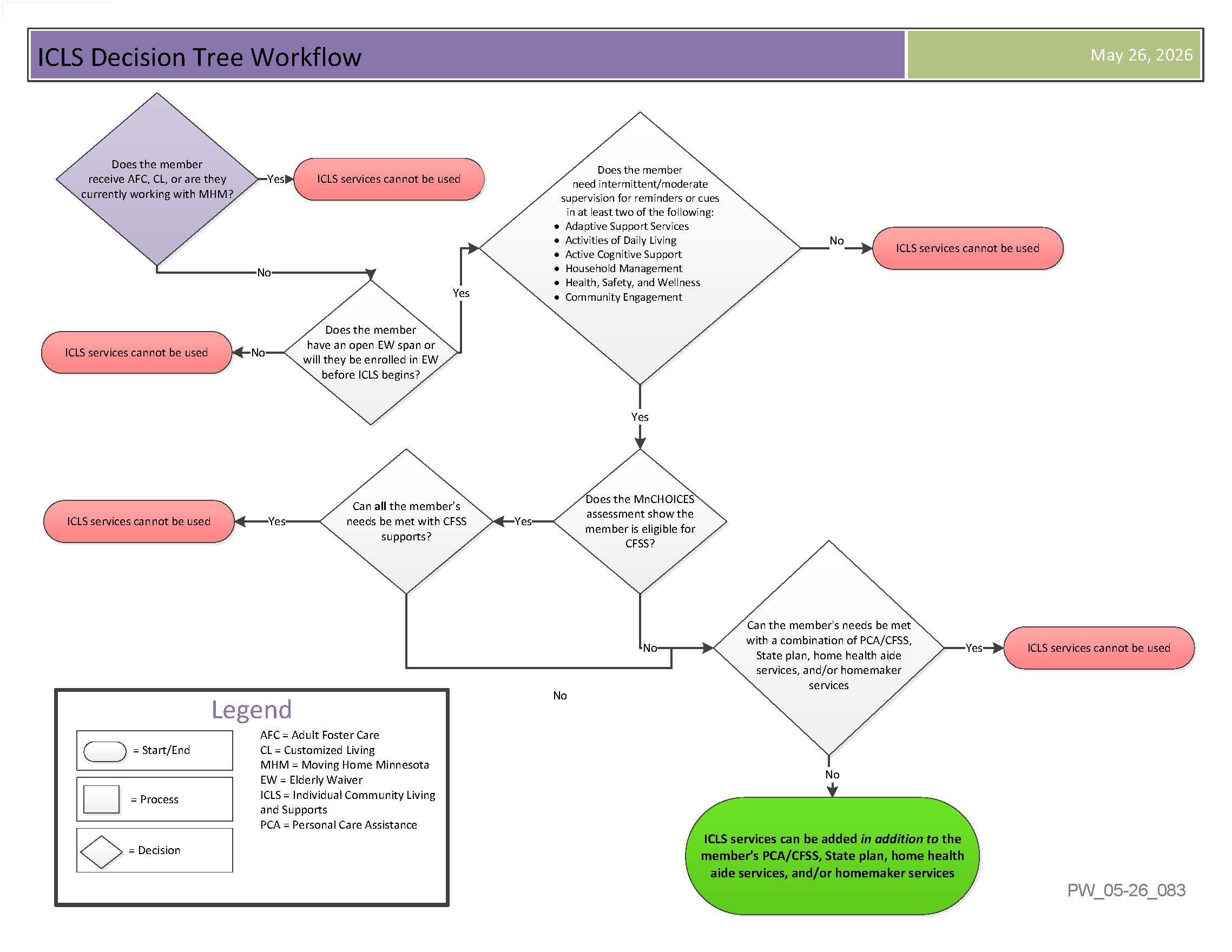
(click image to view full size)
Document the type of support the member will receive for at least two ICLS service components. Make certain to reflect the member’s specific need for units in each of these areas that match the description of the services to be delivered in the Individual Community Living Support (ICLS) Planning Form (DHS-3751).
The MnCHOICES Assessment is used to determine if a member qualifies for EW and has an assessed need for ICLS (refer to the decision tree above) to determine the appropriateness for ICLS services. All members who are receiving EW services must first access Medical Assistance home care services, including PCA/CFSS, to the greatest extent possible before considering additional EW services. If the county case manager is unable to arrange a Medical Assistance home care service for a member who qualifies, the county case manager must document their attempts to arrange this service before initiating EW services. Documentation must include the dates the providers were contacted as well as their response to your outreach (e.g., lack of providers for the areas or for the service you are attempting to arrange for the member). Care coordinators and county case managers ensure authorized units of ICLS reflect the minimum amount necessary to safely and effectively meet the member’s assessed needs without exceeding what is essential for appropriate care.
Based on the member’s assessed needs, a member can be open to EW utilizing ICLS and:
- May receive up to 12 hours of ICLS services per day (i.e. 48 15-minute units per day) and,
- Must have in-person ICLS support scheduled at least weekly and,
- Must receive a minimum of two ICLS services.
The county case manager must submit the ICLS support plan to PrimeWest Health Care Management via email at caremanagement@primewest.org for review. Following review, PrimeWest Heath Care Management staff will enter the service line into PrimeWest Health’s service agreement.
Covered Services
ICLS covers assistance and support in the following six service categories:
- Active cognitive support
- Adaptive support service
- Activities of daily living (ADLs)
- Household management
- Health, safety, and wellness
- Community engagement
The following sections provide more information about and examples of each of the six ICLS service categories.
Active cognitive support
This category includes interventions intended to address cognitive issues and challenges important to the person. Active cognitive supports are the only ICLS services that the person can receive both in-person and remotely. For more information, review the Settings section of the ICLS web page.
Examples of ICLS services covered under this category include the following:
- Problem solving the person’s concerns related to daily living
- Providing assurance to the person
- Observing and redirecting to address behavioral, orientation, or other cognitive concerns
| Service Category | Description/Examples | Considerations |
|---|---|---|
| Active Cognitive Support | Includes supports to help the person with cognitive challenges and issues that are important to them.
Examples
| Reminder tools
Safety checks
Tip: Active cognitive support time is sometimes counted more than once across different service categories. In certain situations, it may occur simultaneously with other tasks. For example, review whether time is being recorded for health, safety, and wellness medication assistance while also assigning additional time for active cognitive support, as this may result in duplication. |
Adaptive support service
This category includes services intended to help the person adopt ways to meet their needs. ICLS adaptive support services include the following:
- Encouraging the person’s self-sufficiency
- Reducing the person’s reliance on human assistance.
Examples of ICLS services covered under this category include the following:
- Verbal, visual, and/or touch guidance to help a person complete a task
- Developing and demonstrating cueing or reminder tools (e.g., calendars, lists)
- Providing verbal, visual, and/or touch guidance to help the person complete a task
- Working through instructions for assistive technology with the person to help them function with greater independence.
| Service Category | Descriptions/Examples | Considerations |
| Adaptive support services | Includes supports to help the person adopt ways to meet their needs. The supports encourage self-sufficiency and reduce reliance on human assistance. Examples
| Estimated Time Example Time for laundry assistance should not include periods when the washer or dryer is running. Laundry
Tip: If verbal prompting is recorded under this category for a specific task, assigning additional time in household management to perform that same task may be duplicative. For example, if time is allotted for cueing related to laundry, separate household management time for completing the laundry would generally not be appropriate. |
Activities of daily living (ADLs)
This component of ICLS includes supports to help the person with ADLs.
Examples
Under this component, an ICLS provider can do the following:
- Provide reminders or cueing systems to complete ADLs.
- Cue and/or provide intermittent physical assistance with dressing, grooming, eating, toileting, mobility, transferring, and positioning.
- Cue and/or provide continual supervision and physical assistance with bathing, as needed.
Note: ICLS is not an appropriate service to meet a person’s need for constant supervision or physical assistance with ADLs throughout the task, except for bathing. Personal care assistance (PCA) is the service designed to meet this level of need for ADL assistance.
| Service Category | Description/Examples | Considerations |
| Activities of daily living (ADL) | Includes supports to help the person with ADLs. Examples
| Bathing assistance may include continual supervision and physical assistance, as needed. All other ADLs are to address needs for cueing and reminders.
Estimated Time Example Dressing and grooming
Reminder: If an individual requires consistent, ongoing reminders during the course of a task each day, this level of support may be better suited for CFSS. |
Household management
This category includes services intended to help the person manage their home. Examples of ICLS services covered under this category include the following:
- Assisting with cleaning, meal planning/preparation, and shopping for household/personal needs
- Assisting with budgets and money management
- Assisting with communications (e.g., sorting mail, accessing email, placing phone calls, making appointments)
- Providing transportation when transportation is integral to ICLS household management goals and community resources and/or informal supports are not available.
| Service Category | Description/Examples | Considerations |
| Household Management | Includes support to help the member manage their home. Examples
Provide transportation when it is integral to ICLS household management goals and when community resources and/or informal support are not available
| Estimated Time Example ICLS providers may also enroll as non-medical transportation providers and simultaneously bill for transportation of participants using the waiver transportation mileage rate.
Drive time should not be included in the service unit authorization as it is billed separately under non-medical EW transportation.
Help with communication
Tip: Household management should align with the same general guidelines used for homemaker services, while also taking in to account whether the individual lives alone or shares a home with family members |
Health, Safety, and Wellness
This category includes services intended to help the person maintain their overall well-being. Examples of ICLS services covered under this category include the following:
- Identifying changes in health needs, and notifying the case manager and/or informal caregivers as needed
- Coordinating or implementing changes to mitigate environmental risks in the home
- Providing reminders about and assistance with exercises and other health maintenance/improvement activities
- Providing medication assistance (e.g., medication refills, reminders, administration, and/or preparation)
- Monitoring the person’s health according to written instructions from a licensed health professional
- Using medical equipment devices or adaptive technology according to written instructions from a licensed health professional.
| Service Category | Descriptions/Examples | Considerations |
| Health, Safety, and Wellness | Includes support to help the member maintain their overall well-being. Examples
| Estimated Time Example Medication assistance
Exercise assistance
Total: 30 minutes per day = 2 units, 7 times per week
|
Community Engagement
This category includes services intended to help the person have meaningful integration and participation in their community. Examples of ICLS services covered under this category include the following:
- Facilitating the person in socially valued roles through engagement in relevant activities that lead to desired outcomes
- Helping the person access activities, services, and resources that facilitate meaningful community integration and participation
- Helping the person develop and/or maintain their informal support system
- Providing transportation when transportation is integral to ICLS community engagement goals and community resources and/or informal supports are not available.
| Service Category | Description/Examples | Considerations |
| Community Engagement
| Includes supports to help the member have meaningful integration and participation in their community. Examples
| Estimated Time Example Care coordinators ensure the most cost-effective service is used to meet the member’s needs. Do not duplicate time if the member already has a bus pass or can use public transportation.
Estimated Time Example Develop informal support system
Help accessing activities
Total: 2 hours per week = 8 units per week |
Non-Covered Services
ICLS does not cover the following:
- Specialized and/or adapted equipment for remote support
- Transportation service
Note: An ICLS provider may enroll as a waiver transportation provider and simultaneously provide ICLS to participants.
EW only
ICLS services are not available to members who:
- Live in adult foster care
- Receive Customized Living services
- Receive comprehensive support through Moving Home Minnesota
- Members whose needs can be addressed with State Plan Home Health Aide, chore, and/or homemaker services
ICLS services should not be used for members who need constant supervision or physical assistance throughout an activity of daily living, except for bathing. This means that members who need an entire task completed for them are appropriate for another service such as PCA/CFSS services.
ICLS services cannot be a duplication of a service that a member already receives, including the following:
- PCA/CFSS services
- Home care services
- Chore services
ICLS services also cannot be used to duplicate services the member is receiving through other support, including adult day care, senior companion, ARMHS, EW Chore, or home-delivered meals.
Planning Form
The county case manager works with the member to complete the ICLS Planning Form (DHS-3751) for the ICLS provider. This form provides information about which services the person will receive. These ICLS services are also included on the member’s support plan/MnCHOICES Assessment Form.
County case managers should keep the following in mind:
- Identify the individual goals that the ICLS service is intended to support
- Describe and provide details about the type of support the member will receive with a minimum of two ICLS service components. Include details such as a thorough explanation of what the ICLS provider will do to assist the member in that area of need. If you indicate that a member will receive shower assistance once a week and then have 2 hours listed, it must be clear why/how that service took two hours.
- Calculate the total number of units and cost of ICLS services the member will receive each week
- The member, county case manager, and ICLS provider must sign the completed ICLS Planning Form (DHS-3751) and the county case manager must provide a copy to the member and the ICLS provider.
- The county case manager may not submit the Waiver Service Authorization Form to authorize ICLS until all signatures are obtained.
- The county case manager is responsible for reviewing and updating the ICLS Planning Form (DHS-3751) at least annually.
Services are calculated in 15-minute units. The following examples are for training purposes only and not intended to represent the minimum or maximum allowable amounts. For services lasting less than 5 minutes, consider if the service can be included in an alternative category. Authorized ICLS should reflect time based on the member’s assessed needs rather than the member's wants. All documentation and time must be tailored to the specific needs of each member.
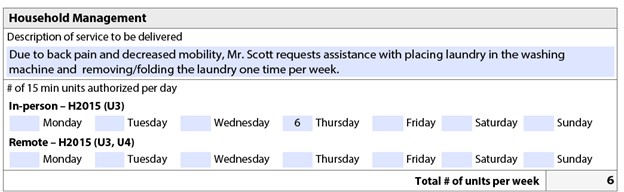
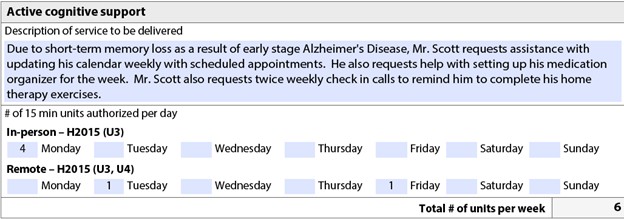
Annual Reassessments
If a member is currently receiving ICLS services, the county case manager must review the need for continuing ICLS services at the next scheduled assessment. If the member does not meet the minimum requirement, the county case manager cannot reauthorize ICLS. Instead, the county case manager is expected to authorize the service that meets the member’s identified needs.
When A Member’s Needs Change
When a member experiences a significant event such as hospitalization, the county case manager should re-assess the member to determine if their needs have changed regarding PCA/CFSS or ICLS services. If it is determined a change should be made, add detailed documentation as to why the change is being made and when a re-assessment will occur.
Providing Oversight
It is not sufficient to evaluate a member’s status and need for ICLS services only once per year. Regular review should be scheduled at least every six months and when a member experiences an event such as a hospital stay or significant change in health.
If a member is currently receiving ICLS services, the county case manager must review the need for ICLS services at the next scheduled review to ensure the member’s needs meet the requirement of at least two ICLS components. If the member does not meet the minimum requirement, the county case manager or care coordinator cannot reauthorize ICLS. Instead, they must authorize the service that meets the member’s identified need. For more information, refer to DHS’s Individual community living supports (ICLS) web page.
Settings
The person can receive active cognitive support services either:
- In person
- Remotely via real-time, two-way communication between the person and the provider (e.g., phone, live video).
The person must receive all other service categories in-person. The person must receive in-person ICLS services in a single-family home or apartment that they or their family own or rent (as demonstrated by a lease agreement). In a rental scenario, the person their family must maintain control over the individual unit.
The person must receive ICLS services in-person once per week.
Transportation
An ICLS provider also may enroll with PrimeWest Health as a waiver transportation provider. An ICLS provider who is also an MHCP-enrolled waiver transportation provider can bill separately for mileage reimbursement. For the current waiver transportation mileage rates, review Long-Term Services and Supports (LTSS) Service Rate Limits (DHS-3945).
ICLS Providers
ICLS services providers must be enrolled as a DHS provider and meet DHS licensure requirements (MN Stat. Chap. 245D). An ICLS services provider may be a relative, although not a spouse, a non-professional legal guardian, or conservator to the member if certain criteria are met. For more information, refer to DHS’s Paying relatives and legally responsible individuals web page.
ICLS providers cannot be any of the following:
- The spouse of a member
- A licensed assisted-living provider where the member resides
- A home care provider in an affordable housing setting where the member resides
- A professional legal guardian or conservator to the member
- The member’s landlord
- Anyone who has a financial interest in the member’s housing, including a family member who owns the home or apartment, collects rent or mortgage payments from the member, or receives housing subsidies tied to the member living there
Clear documentation must be included to reflect that the county case manager has reviewed the provider standards and qualifications and that the ICLS provider the member has selected is an allowed provider. An example of this documentation is as follows, “Member has indicated that they would like their niece to be their ICLS provider. Reviewed the provider standards and qualifications with the member and confirmed member’s niece could be an allowed ICLS provider.”
Providers of ICLS services must meet license requirements outlined on DHS’s Waiver/AC service provider overview web page.
Authorization, Rates, and Billing
- Providers delivering in-person services should bill H2015 (U3) using the 15-minute unit. If the provider also delivers remote services on the same day as in-person services, bill for the remote time using H2015 (U3, U4).
- Face-to-face in-person support must be provided at least once weekly. The maximum time billed for remote service using H2015 (U3, U4) is 15 minutes, or one unit per day.
- If the only service provided in a day is provided remotely, bill H2015 (U3, U4) using the daily remote rate. A full day constitutes 24 hours, beginning at 12:00 a.m. and ending at 11:50 p.m.
Effective March 10, 2025, Individual Community Living Support (ICLS) is limited to 12 hours (48 15-minute units) per day for H2015 (U3) and H2015 (U3, U4) combined.
Effective June 1, 2026, PrimeWest Health requires that county case managers submit member ICLS support Plans to PrimeWest Health’s Care Management team via email at caremanagement@primewest.org for review. Following review, PrimeWest Heath Care Management staff will enter the service line into PrimeWest Health’s service agreement.
Additional Resources
- CBSM – Alternative Care
- CBSM – Elderly Waiver
- CBSM – Rate methodologies for EW service authorization
- CBSM – Additional square footage
- CBSM – Guide to home modifications under the environmental accessibility adaptations (EAA) service
- CBSM – Monitoring technology usage
- CBSM – Waiver general process and procedures (BI, CAC, CADI, DD)
- CBSM – Waiver/AC reimbursement for unforeseen circumstances
- New Service for Elderly Waiver and Alternative Care: Individual Community Living Support (DHS bulletin #17-25-02)
PW_11-19_542
Updated_09/18/2026

